


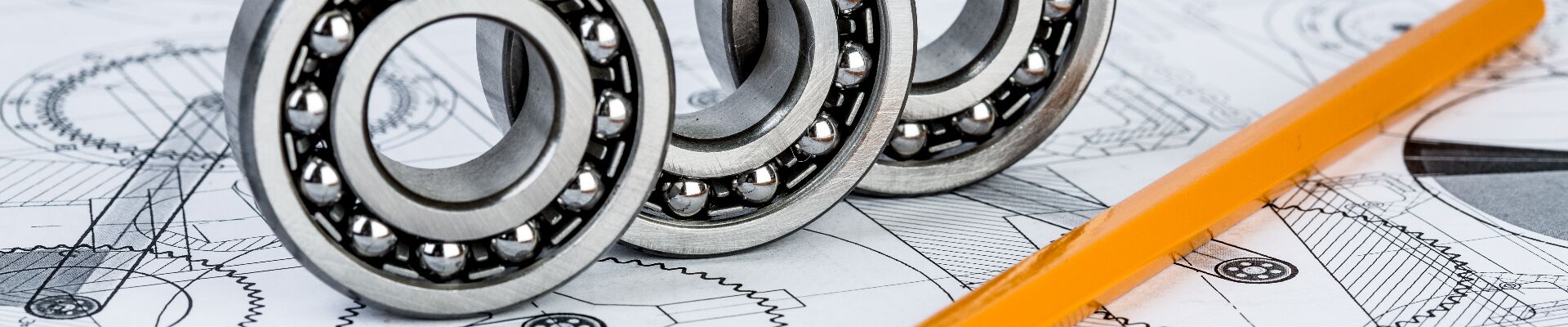
Crankshaft Bearing Structure, Fit, and Support Methods
I. Function and Usage Requirements of Crankshaft Bearings
Crankshaft bearings include connecting rod bearings and main bearings. Their function is to protect the journals and bearing bores, reducing friction and wear. They convert the gas force transmitted from the piston-connecting rod assembly into torque for external output. They are also used to drive the engine's valve train and various other auxiliary devices.
Usage Requirements: They all withstand alternating loads and high-speed friction; therefore, the bearing materials must have sufficient fatigue strength, low friction, wear resistance, and corrosion resistance.
II. Structure of Crankshaft Bearings
Both connecting rod bearings and main bearings consist of upper and lower bearing shells mated together. Each bearing shell is composed of a steel backing and an anti-friction alloy layer, or a steel backing, an anti-friction alloy layer, and a soft plating layer. The former is called a two-layer bearing shell, and the latter is called a three-layer bearing shell.
1. Steel Backing and Anti-friction Layer
The steel backing is the base material of the bearing shell, made of 1-3mm thick low-carbon steel. The anti-friction layer is a 0.3~0.7mm thick anti-friction alloy, which is relatively soft and can protect the journal.
Anti-friction layer materials:
(1) White alloy (Babbitt alloy): Good anti-friction performance, but low mechanical strength and poor heat resistance. Commonly used in gasoline engines with low loads.
(2) Copper-lead alloy: High mechanical strength, high load-bearing capacity, and good heat resistance. Mostly used in high-load diesel engines. However, its anti-friction performance is poor.
(3) Aluminum-based alloy: There are three types: aluminum-antimony-magnesium alloy, low-tin aluminum alloy, and high-tin aluminum alloy. The first two have good mechanical properties and strong load-bearing capacity, but poor anti-friction performance. Mainly used in diesel engines; the latter has both good mechanical properties and anti-friction performance, and is widely used in diesel and gasoline engines.
2. Positioning key and oil groove
The connecting rod bearing has a positioning key, which is used to embed into the positioning groove of the connecting rod big end and connecting rod cap during installation to prevent the bearing from moving back and forth or rotating. The bearing bush also has oil holes and oil grooves, which should be aligned with the corresponding oil holes during installation.
III. Crankshaft Bearing Free Force and Interference Fit
1. Free Force: The radius of curvature of the bearing bush in its free state is slightly larger than the radius of the bearing seat. The difference in diameter is called the free force or opening. For gasoline engines, it is generally 0.8~1.5mm, and for diesel engines, it is 1.5~2.5mm.
2. Interference Fit: Because the outer diameter circumference of the bearing bush is slightly larger than the circumference of the bearing seat, a certain interference fit is generated after the connecting rod bolts are tightened. This ensures that the bearing bush does not rotate, shift, or vibrate during operation, allowing for a tight fit between the bearing bush and the bearing seat to facilitate heat dissipation. The bearing overhang is generally 0.04~0.09mm.
Inspection: After installing the bearing into the bearing seat, tighten the bolts on both sides to the torque specified by the manufacturer. Then, completely loosen the bolt on one side and use a feeler gauge to check the clearance between the bearing bearing seat and the bearing bore. This clearance is the bearing overhang. IV. Crankshaft Thrust Bearing
Function of Crankshaft Thrust Bearing: When a vehicle is in motion, the clutch pedal applies axial thrust to the crankshaft, causing axial movement. Excessive axial movement will affect the normal operation of the piston connecting rod assembly and disrupt proper valve timing and diesel engine injection timing. Thrust bearings are required to ensure axial positioning of the crankshaft.
Thrust bearings can only be installed in one location to ensure the crankshaft can freely expand when heated. Main types include:
1. Flanged bearing shell
2. Semi-circular thrust washers
3. Circular thrust washers
Installation Precautions: The side of the thrust washer with the anti-friction layer (the side with the oil groove) faces the rotating parts. When the crankshaft moves forward, the rear thrust washer bears the axial thrust; when it moves backward, the front thrust washer bears the axial thrust.
Axial Clearance Adjustment: Replace with thrust washers of different thicknesses, or change the thickness of the thrust washers. (The standard is generally 0.07~0.17mm, with an allowable limit of 0.25mm).
V. Crankshaft Support Methods
A crankshaft with a main journal between every two adjacent crankshafts is called a fully supported crankshaft; otherwise, it is called a partially supported crankshaft.
1. Fully Supported Crankshaft:
Advantages: Increases crankshaft rigidity and bending strength; reduces the load on the main bearings.
Disadvantages: Increases the number of machined surfaces on the crankshaft, increases the number of main bearings, and lengthens the engine block.
Applications: Widely used; diesel engines generally employ this support method.
2. Partially Supported Crankshaft:
Advantages: Shortens the crankshaft length, reducing the overall engine length.
Disadvantages: Requires a higher load on the main bearings.
Applications: Gasoline engines with lower load requirements can use this method.
Post time: Feb-06-2026


