


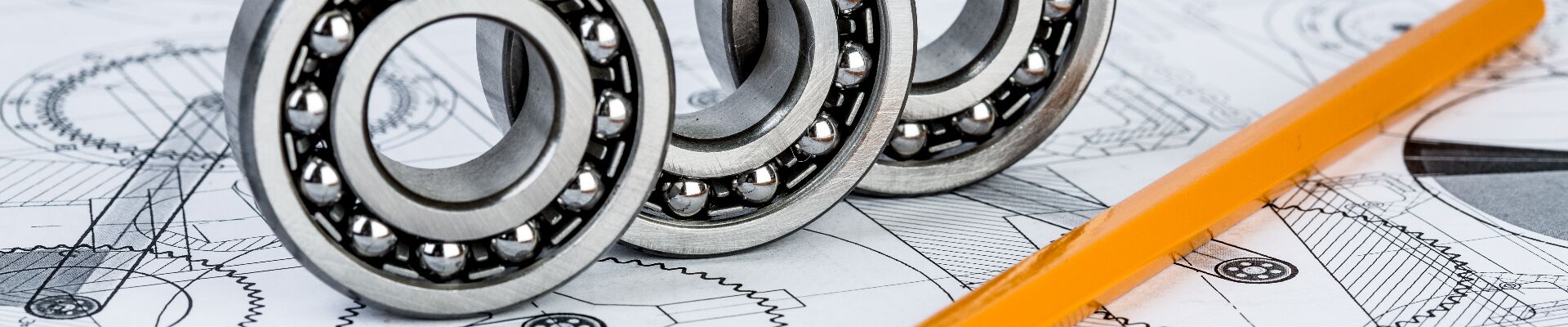
Mastering Bearing Drawing Reading: A Fundamental Skill in Industrial Applications
Bearings, as key components in rotating equipment, are widely used in various mechanical systems, including motors, gearboxes, fans, and pumps. During equipment installation, maintenance, and replacement, accurate understanding of bearing drawings is essential for ensuring proper component fit and reliable operation. Drawings not only convey design intent but also serve as the technical basis for on-site operations. Their ability to read and interpret them directly impacts work efficiency and quality.
I. Common Drawing Types and Their Uses
In practical work, bearing drawings commonly encountered include the following:
Part drawings: These provide detailed information about individual bearings or mating components (such as shafts and end caps), including complete dimensions, tolerances, materials, and surface finish requirements. They emphasize precise manufacturing and inspection.
Assembly drawings: These depict the assembly relationship between the bearing and components, such as the shaft, housing, and seals, guiding the installation sequence and fit. Critical mating dimensions and preload requirements are often noted.
Cross-section drawings: These imaginary cuts through the component clearly illustrate internal structures, such as rolling element arrangement, cage type, and seal structure, helping to understand the operating principle and spatial layout.
Each drawing has different focuses, so they should be used in conjunction when interpreting to fully understand the assembly relationships and technical requirements.
II. Interpretation of Key Symbols and Technical Parameters
Drawings contain numerous standardized symbols and codes, and their meanings must be systematically understood:
Bearing model: For example, "6206." "6" represents a deep groove ball bearing, "2" represents the size series, and "06" corresponds to a 30mm inner diameter. Special suffixes such as "C3" indicate a clearance greater than the standard set, and "RS" indicates a single-sided contact seal.
Dimensional tolerance: A notation such as "Φ50(-0.012)" indicates a 50mm diameter with a lower tolerance of -0.012mm. The assembly effect should be judged based on the nature of the fit (interference, clearance).
Geometric tolerances: Common symbols include coaxiality (◎), cylindricity (○), and end runout (⊥). These are used to control geometric accuracy and affect bearing smoothness.
Surface roughness: Expressed as an "Ra" value, such as "Ra1.6," refers to the average profile deviation of the machined surface, which directly affects lubricant film formation and wear rate.
These parameters collectively determine the bearing's installation conditions and service life and must be accurately identified.
III. Drawing Interpretation Methods and Practical Training
Improving drawing interpretation skills requires a combination of theory and practice:
Establishing spatial correspondences: Visualize 3D structures using 2D views. Use section line direction and projection alignment rules to aid judgment. For example, the front view and left view should have the same width, and the top view and front view should align in length.
Analyze the drawing content step by step: First, identify the object by looking at the title bar, then read the views to understand the structure, then analyze the dimensional chain and tolerance requirements, and finally, check the technical specifications.
Compare with the actual object or 3D model: Observe the actual bearing structure and understand how non-metallic components such as cages and seals are represented in the drawing.
Participate in practical tasks: When replacing bearings, surveying old parts, or assembling equipment, proactively consult the drawings and verify information to gain experience.
Bearing drawing interpretation is not a skill that can be acquired overnight. As you work with more drawing types, you'll encounter non-standard designs and special working condition annotations, necessitating constant updating of your knowledge. It's recommended to regularly review national standards for mechanical drawing (such as GB/T 4457–4459), stay updated on industry technology updates, and document common problems and solutions during your work.
If you want to know more bearing information,please contact us :
sales@cwlbearing.com
service@cwlbearing.com
Post time: Dec-11-2025


