


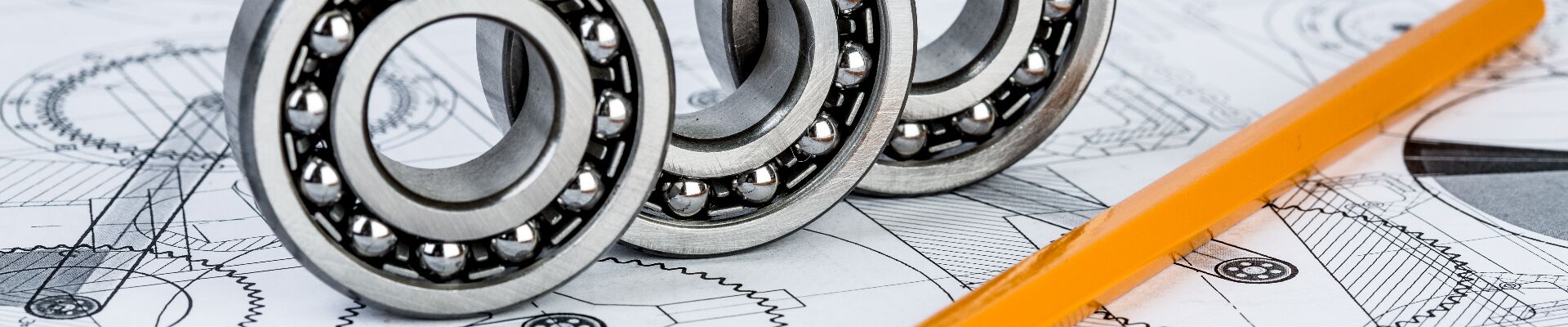
One-way bearing principle
A one-way bearing is a type of bearing that rotates freely in one direction and locks in the other. The metal housing of a one-way bearing contains many rollers, needle rollers or balls, and the shape of the rolling seat (hole) makes it roll in only one direction, and generates a lot of resistance in the other direction (the so-called "one-way").
The working principle of one-way bearings
1. Ramp and roller design
Ramp and roller type one-way clutches basically consist of an outer ring with a barrel inner diameter, an inner ring with a ramp, and a set of rollers that are subjected to spring forces and are always in close contact with the inner and outer rings. As long as the rotation of one raceway in the direction of its motion has an effect on the other, this arrangement essentially ensures immediacy beyond the speed and the ability to drive immediately.
The use of this type of one-way clutch can be suitable for overtaking, indexing and non-reversal use in various environments.
When used as a transcendent one-way clutch
The ramp-type roller one-way clutch will be installed in this way, i.e. the outer ring will be used as an override member. This is very important for high-speed overtaking. In the case of inner ring overtake, the centrifugal force acting on the rollers will limit the overtake speed.
When used as a non-reverse one-way clutch
Only the ramp roller type one-way clutch with inner ring rotation is suitable for relatively low speeds. If a higher speed is required, a wedge-type one-way clutch is recommended.
When used as an indexing one-way clutch
The outer ring is often seen as a swinging element, and the inner ring is often seen as a slave element. Otherwise, the inertia of the rollers and springs will lead to errors, especially at high frequency indexing. The use of diluted lubricating oil and powerful springs provides high speed indexing accuracy and high quality.
2. Wedge design
This wedge-type one-way override clutch is generally composed of an inner ring, an outer ring, a wedge group, a wedge cage, a strong spring and a bearing. The wedge is wedged between the inner and outer rings to transfer power from one raceway to another. The wedge has two diagonal diameters, (i.e. the distance from one corner of the wedge to the other) and one of them is greater than the other. The wedge action occurs when the inner and outer rings rotate relative to each other, forcing the wedge to have a larger vertical position on a relatively large cross-section.
3. The self-locking angle wedge effect mainly depends on the wedge and self-locking angle of the wedge between the inner and outer rings. The basic concept of a wedge one-way clutch requires that the coefficient of friction of the wedge is related to the sudden torque generated by the inner ring in the direction of drive, and this friction value must be greater than the tangent value of the self-locking angle. If the conditions are unsafe, wedge will not occur.
The self-locking angle is determined by the structure of the wedge, and the points on the inner and outer rings are connected with the wedge respectively.
The design of the wedge has a very low initial self-locking angle to ensure absolute bonding at the start. As the torque increases, a radial force is generated on the wedge that deflects the wedge raceway, causing the wedge to roll to a new position. The wedge is often designed to have a self-locking angle that can be gradually increased, just as it goes from the override position all the way to the position where the maximum load is beared. The relatively large self-locking angle reduces the radial force generated by the wedge, so that large torques are allowed to be transmitted as long as the elongation and Brinell hardness limits are required.
The main uses of one-way bearings: textile machinery; Printing machinery ; automotive industry; Household appliances; Counterfeit detector.
Post time: Aug-20-2025


