


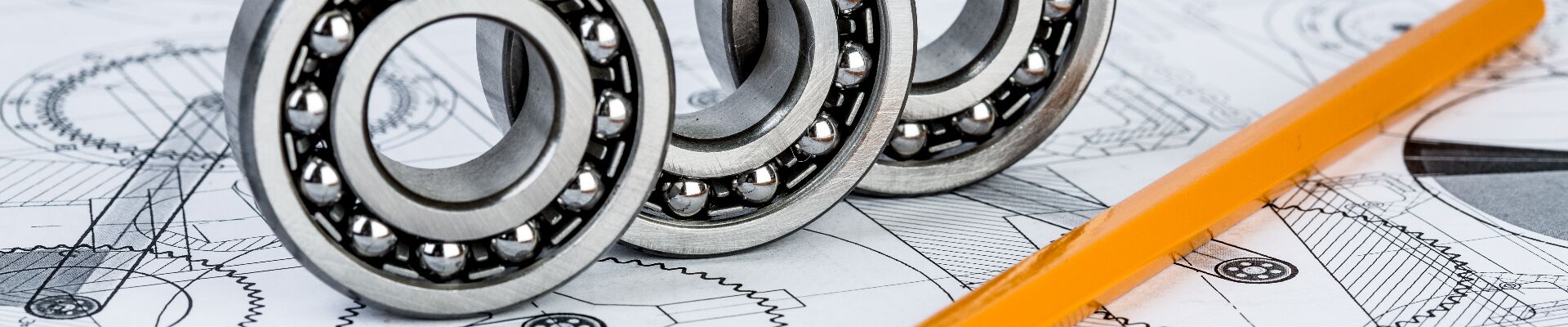
Railway rolling stock bearings
Railway rolling stock bearings refer to bearings used in locomotives and rolling stock. The bearings on the locomotive include axle box bearings, traction motor bearings, transmission system bearings, power unit bearings and cooling system bearings, etc., while the bearings on the vehicle are mainly axle box bearings, passenger car axle boxes mostly use short cylindrical roller bearings, and the axle boxes of freight cars mainly use tapered roller bearings, and the variety, structure and performance of vehicle bearings are basically similar to locomotive axle box bearings.
1. Axle box bearing
The locomotive wheel is connected with the locomotive body through the axle box, spring and bogie frame, and the axle box bearing directly bears the spring gravity of the locomotive and the radial and axial impact of the rail on the wheel, in addition to transmitting the traction force and some additional loads generated thereby, so the axle box bearing must have a large bearing capacity, can withstand shock and vibration, and must have a high life, safety and reliability, small size and quality; Easy to inspect and maintain, etc. Therefore, locomotive bearings often use non-standard series of bearings and special bearing technical conditions, and the commonly used rolling bearings have the following three categories.
(1) Cylindrical roller bearings Most axles of diesel locomotives and electric locomotives use cylindrical roller bearings. There are two main types.
1) Four rows of cylindrical roller bearings
China's locomotive axle box bearing was the earliest to use, and the largest number of loaded is the four-row cylindrical roller bearing 972832 type. The bearing has a high load capacity and long life, and its rated dynamic load is 1445kN. Since it can only bear radial loads, not axial loads, it is necessary to set up a device to withstand axial forces in the axle box.
2) Double row cylindrical roller bearings
China's Dongfanghong 2, 3, 5, 21 and Beijing locomotive axle boxes all use double-row cylindrical roller bearings 982832T, which bear radial forces, and angular contact ball bearings 146132T bear axial loads.
The advantage of using spherical roller bearings is that there is no tilt compensation device between the axle box and the bogie frame. The axle box bearing of the ND2 diesel locomotive is a C-type spherical roller bearing. Its model is comparable to the domestic bearing 3G4053736KT. The rollers of this type of bearing are symmetrical, the inner ring has no outer flange, the middle flange is separable, the roller is in line contact with the outer ring, the effective working length of the roller is longer, and the service life is slightly larger than that of the asymmetrical spherical roller bearing with the same outer dimension.
This type of bearing used in the axle box of the locomotive is a double-row tapered roller bearing, and the ND5 diesel locomotive is equipped with an AP type bearing. This type of bearing is an inch size, and is commonly used in B, C, D, E, F, G and other levels, which are used for different grades of axles.
2. Traction motor bearing
(1) Traction motor armature bearing
The traction motor is the main equipment in the transmission system of electric locomotives and electric drive diesel locomotives, and the armature bearing is one of its main components.
1) Bearings for single-side transmission
The armature is usually supported by double fulcrums, the output end of the mounting gear is a traveling support, and the commutator end is a positioning support. The output bearing is positioned close to the gear, which is the most stressed, and is the key bearing of the two bearings of the armature. In order to reduce the load, the NU type of cylindrical roller bearing with no inner ring flange is generally used. The commutator end generally adopts the cylindrical roller bearing NUP type with a single flange with a single flange with a flat retaining ring on the inner ring, and there are also cylindrical roller bearings with a single flange with an inner flange and a bevel retaining ring at the commutator end.
2) Bearings for double-side transmission
When the motor power is large, if the single-side transmission is still used, the bearing load at the gear end is too large, and it is difficult to select the bearing that the rated dynamic load and the ultimate speed can meet the requirements, so the double-sided transmission mode can be changed under the condition that the motor design allows. The advantage of double-sided transmission is that helical cylindrical gears can be used, so that the helix angles of the two gears are equal and the rotation direction is opposite, so as to obtain a relatively stable transmission quality without generating axial load. The bearing suitable for this purpose is the cylindrical roller bearing NU type without flange in the inner ring, if the spur cylindrical gear is still used for double-sided transmission, the bearing that can withstand a certain axial force should be selected, and the cylindrical roller bearing NJ type with a single flange in the inner ring is generally used.
(2) Traction motor bearing shaft bearing
Axle-mounted traction motors are usually supported on the bogie by a adjusting rod on one side, and on the axle on the other side by a shaft bearing. Cylindrical roller bearings, spherical roller bearings and tapered roller bearings have been used.
Cylindrical roller bearings are suitable for high-speed locomotives, and their grease replenishment cycles are long, and the installation and maintenance are relatively simple, especially when using the integral shell, this advantage can be fully demonstrated. The installation rigidity of tapered roller bearings is good, which is conducive to ensuring the meshing accuracy of gears, but it is difficult to adjust their assembly and disassembly and axial clearance. The installation of two sets of spherical roller bearings, especially the disassembly, is more difficult than that of tapered roller bearings, but can accommodate the bending of the shaft. The shaft bearing of the traction motor of electric locomotive in China adopts a spherical roller bearing, and its model is 3G3053148T.
(3) Traction generator bearings
The body of a modern electrically driven diesel locomotive traction generator is usually installed on the end face of the body at the output end of the diesel engine. Whether it is installed in this way or otherwise, the input end of the armature is rarely equipped with bearings, and the armature is generally supported on the crankshaft or output shaft of the diesel engine through an elastic coupling, so as to shorten the longitudinal size of the generator.
The outer end of the armature shaft can generally be used with cylindrical roller bearings, and sometimes in order to be more convenient to align with the diesel engine during installation, spherical roller bearings can also be used.
3. Bearings of the hydraulic transmission system of diesel locomotives
The hydraulic transmission system of diesel locomotive generally includes three parts: hydraulic transmission box, cardan shaft, and axle gearbox. Shunting locomotives sometimes also include a working condition gearbox, which is fitted with a considerable number of rolling bearings.
(1) Hydraulic gearbox bearing
The working mode of the hydraulic transmission box is to convert the power of the diesel engine into the power of the driving locomotive through the hydraulic torque converter when the train is being pulled; When applying power braking, the hydraulic brake is used to absorb the kinetic energy of the locomotive wheels. A number of shaft systems are arranged in the hydraulic gearbox, and the support of each shaft is all with rolling bearings.
(2) Intermediate gearbox bearing
The main components of the intermediate gearbox are the input shaft and the output shaft each with two gears, and the gear on one of the shafts is a shift gear, and the shaft and its gear have a clutch mechanism, which can make one of the gears connect with the shaft and transmit power; The other gear is just idling in this case. The shift gear and clutch are often arranged on the input shaft, because the input torque is small, which is conducive to reducing the size of the spline clutch and the size of the bearing.
(3) Axle gearbox bearing
4. Diesel engine crankshaft bearing
The main advantages of the diesel engine crankshaft bearing using rolling bearing are limited to high-speed diesel engine, which is: small friction loss, high mechanical efficiency, reliable work and long service life; Easy lubrication, small size of oil radiator, etc. Compared with the use of sliding bearings, its main disadvantages are: high price, large quality, high technical requirements for assembling bearings and crankshafts, inconvenient maintenance and replacement, and large noise.
For single-cylinder and double-cylinder small diesel engine crankshafts, class 0 rolling bearings are mostly used; For high-speed and high-power diesel engine crankshafts, because of their large loads, only cylindrical roller bearings are generally used.
Post time: Jul-28-2025


