


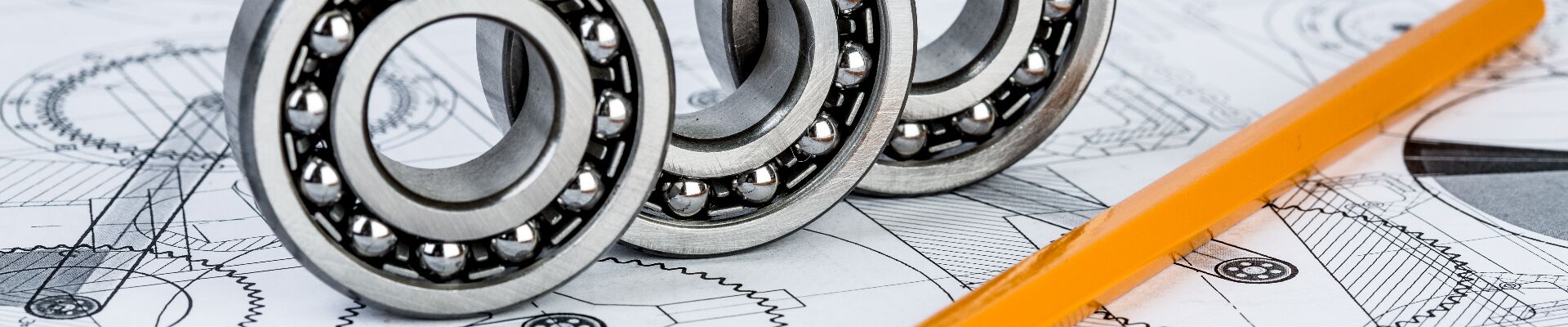
Two types of bearings commonly used in industrial robots
Equal-section thin-section bearings and crossed cylindrical roller bearings are the two main categories in the application of industrial robots. In addition, there are harmonic reducer bearings, linear bearings, joint bearings, etc.
The bearing of industrial robots is one of its key accessories, which is most suitable for a wide range of applications such as joint parts or rotating parts of industrial robots, rotating tables of machining centers, rotating parts of manipulators, precision rotating tables, medical instruments, measuring instruments, and IC manufacturing equipment.
Characteristics of industrial robot bearings: can withstand comprehensive loads in axial, radial, overturning and other directions; Thin-walled bearings; High slewing positioning accuracy. Any bearing that meets this design requirement can be used in industrial robot arms, slewing joints, chassis, and more.
Characteristics of crossed roller bearings: Crossed roller bearings are cylindrical rollers or tapered rollers on a 90-degree V-shaped groove rolling surface through isolation blocks that are arranged perpendicular to each other, so crossed roller bearings can withstand multi-directional loads such as radial load, axial load and torque load. The size of the inner and outer rings is miniaturized, and the ultra-thin form is close to the limit of small size, and has high rigidity, and the accuracy can reach P5, P4, and P2 levels. Therefore, it is suitable for joint and rotating parts of industrial robots, rotary tables in machining centers, precision rotary tables, medical machines, calculators, military industry, IC manufacturing equipment, and other equipment.
1. Excellent rotation accuracy:
The internal structure of the cross roller bearing adopts the rollers arranged vertically and cross each other at 90°, and the rollers are equipped with interval retainers or isolation blocks, which can prevent the tilting of the rollers from rubbing against each other, and effectively prevent the increase of rotational torque. In addition, there will be no contact or locking phenomenon of one side of the roller; At the same time, because the inner and outer rings are divided, the clearance can be adjusted, and high-precision rotational motion can be obtained even when prepressure is applied.
2. Simplified operation and installation:
The outer or inner ring, which is divided into two parts, is fixed together after the rollers and retainers are attached, so installation is very simple.
3. Bear large axial and radial loads:
Because the rollers are arranged perpendicular to each other by spacer retainers on a V-groove rolling surface at 90°, this design allows crossed roller bearings to withstand loads in all directions, including large radial, axial and torque loads.
4. Greatly save installation space:
The size of the inner and outer rings of crossed roller bearings is minimized, and in particular, the ultra-thin structure is close to the limit, and it has high rigidity, so it is ideal for a wide range of applications, such as joint parts and rotating parts of industrial robots, rotating tables of machining centers, rotating parts of manipulators, precision rotating tables, medical instruments, measuring instruments, and IC manufacturing equipment.
2. Equal section thin-wall bearings
Equal section thin section bearings are composed of seven open series and five sealed series. The open series is available in three types: radial contact type C, angular contact type A and four-point contact type X. Advantages of thin-walled equal-section bearings: Thin-walled bearings achieve extremely thin bearing cross-sections, and also realize the miniaturization and lightweight of products. The diversity of products expands their range of uses.
Product characteristics of thin-walled equal-section bearings: In order to obtain the low friction torque, high rigidity and good rotational accuracy of the bearing, steel balls with small outer diameter are used. The use of hollow shafts ensures light weight and wiring space. Thin-walled 6700 and 6800 series have a variety of dust cover forms, flanged types, stainless steel types, wide width types, etc., with a complete variety.
The main uses of thin-walled and equal-section bearings: stepper motors, medical equipment, office equipment, testing instruments, deceleration/variable speed devices, industrial robots, optical/imaging instruments, rotary encoders.
Thin-walled equal-section bearings, also known as thin-walled ferrule bearings, have high precision, are very quiet and have a strong load-bearing capacity. Thin-walled ferrule bearings can be deep groove ball bearings, four-point contact bearings, angular contact ball bearings, and most of the cross-sectional cross-sections of thin-walled bearings are square. In these series, the cross-section remains the same even with larger shaft diameters and bearing bores. These bearings are therefore called equal sections. It is this characteristic that distinguishes thin section ferrule bearings from conventional bearings in the standard ISO series. Therefore, larger cross-sections can be selected and bearings with higher load-bearing capacity can be used without having to change the shaft diameter. Thin-section ferrule bearings can be designed to be extremely lightweight bearings that require little space.
Post time: Mar-26-2026


