


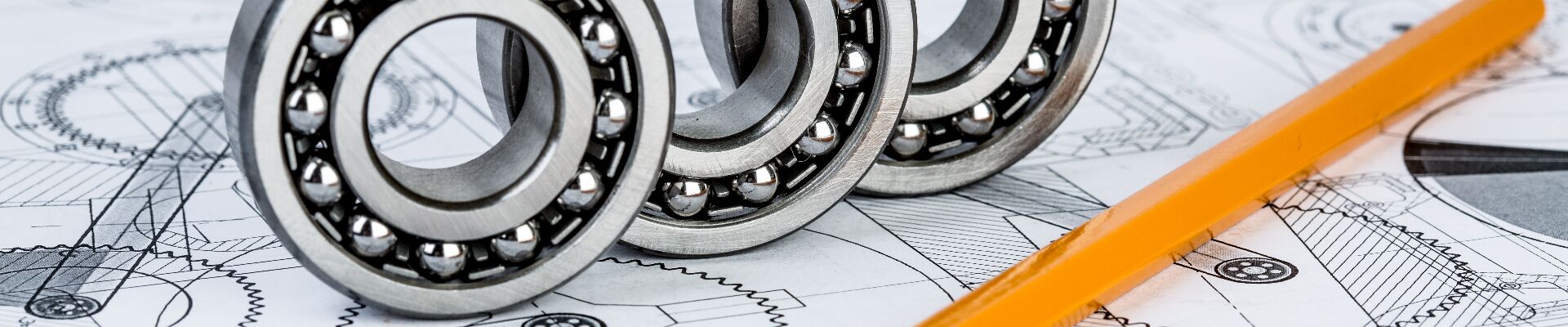
Four-Point Contact Ball Bearings
Four-point contact ball bearings are a type of separable, single-row radial angular contact ball bearing. As fundamental components in industrial machinery, they are primarily used in applications subject to high axial loads, such as engines, lifting equipment, and robotics [1-2]. Their inner and outer rings feature a "gothic arch" (or "pear-shaped") raceway cross-section. Under zero load or purely radial load, the steel balls make contact with the rings at four points; under a purely axial load, this shifts to two-point contact. Combining the functionalities of both single-row and double-row angular contact bearings, they are capable of accommodating combined radial and bidirectional axial loads.
These bearings utilize a split inner or outer ring design; a split inner ring, in particular, allows for the inclusion of more steel balls, thereby increasing load-carrying capacity. The contact angle is typically 35° or 45°. Compared to double-row bearings, they offer advantages such as a smaller axial footprint, higher limiting speeds, and reduced axial clearance. The split-ring design facilitates installation and allows for optimized lubrication when paired with cylindrical roller bearings. Typical specifications cover bore diameters ranging from 16 mm to 650 mm and rotational speeds from 1,500 to 17,000 rpm. They are designed for applications requiring controlled bolt preload torque and periodic lubrication maintenance.
When subjected solely to an axial load, the steel balls and rings make contact at two points, allowing the bearing to support axial loads in both directions. Four-point contact ball bearings can also accommodate moment loads, effectively serving the functions of both single-row and double-row angular contact ball bearings. Proper operation is ensured only when the bearing maintains two-point contact; therefore, they are generally suited for applications involving pure axial loads or combined loads where the axial component is dominant enough to establish two-point contact. Furthermore, due to their high limiting speeds, they are well-suited for high-speed operating environments.
Characteristics of Four-Point Contact Ball Bearings
Four-point contact ball bearings feature a separable design, allowing a single bearing to replace a pair of angular contact ball bearings arranged in a "face-to-face" or "back-to-back" configuration. These bearings can accommodate radial loads and bidirectional axial loads, and can limit axial displacement in both directions; furthermore, they occupy less axial space than equivalent double-row angular contact ball bearings.
Compared to other types of ball bearings, four-point contact ball bearings exhibit smaller axial clearance (given the same radial clearance) and a higher limiting speed.
Four-point contact ball bearings are suitable for applications involving pure axial loads or combined axial and radial loads where the axial component is dominant. Because they feature a split inner (or outer) ring, they can accommodate a larger number of balls, resulting in a higher load-carrying capacity.
Under normal operating conditions, these bearings form a contact angle when subjected to an axial load from either direction. The steel balls make contact with the inner and outer raceways at single points, which helps prevent significant sliding friction within the contact zones. Consequently, these bearings are not well-suited for applications where radial loads are the primary force.
Post time: Oct-23-2026


