


Fundamentals and Manufacturing Processes of Bearings
The typical production process for bearings is as follows: Raw materials → processing of inner and outer rings, steel balls or rollers, and cages (stamped or solid) → bearing assembly → finished bearing.
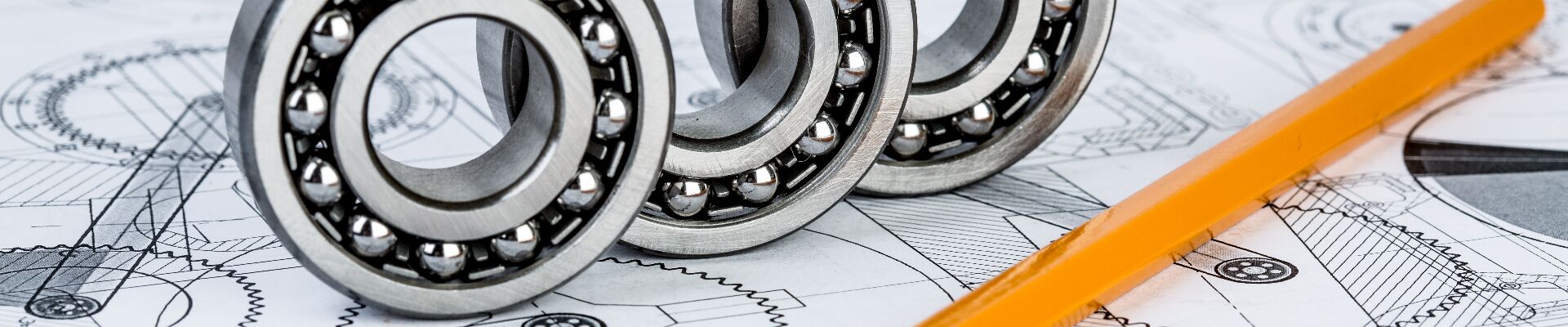
A bearing is primarily composed of raw materials, inner and outer rings, rolling elements (steel balls or rollers), and a cage.
Classification of Rolling Bearings
Based on the type of rolling elements, rolling bearings are classified into:
(1) Ball bearings
(2) Roller bearings
Distinguishing Between Cylindrical Roller Bearings and Needle Roller Bearings:
In terms of shape, there are two criteria for distinguishing between needle rollers and cylindrical rollers: one uses a length-to-diameter ratio of 2.5 as the threshold, while the other uses a ratio of 4.
From the perspective of load-bearing, needle rollers cannot withstand any axial force (their end faces are not ground; contact with a shoulder would result in excessive friction). In contrast, cylindrical rollers—if the raceway includes a shoulder—can support a certain amount of axial force, though it must be limited (generally not exceeding 1/10 of the radial load).
Regarding applications, needle rollers are primarily used in space-constrained environments, making them common in automobiles, motorcycles, and textile machinery. Furthermore, the inner ring for a needle roller bearing is optional; if the shaft meets the necessary requirements for hardness and surface roughness, the inner ring can be omitted (which saves space). However, if the shaft’s surface quality is insufficient or the material is too soft, a separate inner ring must be used to serve as the raceway. Cylindrical rollers are frequently used to support the "floating" end of a shaft, allowing for thermal expansion. Four-row cylindrical roller bearings are commonly used in rolling mills, primarily due to their exceptionally high load-carrying capacity. Classification of rolling bearings based on external dimensions:
1. Miniature bearings: bearings with a nominal outer diameter (D) < 26 mm.
2. Small bearings: bearings with a nominal outer diameter (D) in the range of 26 ≤ D < 60 mm.
3. Medium-small bearings: bearings with a nominal outer diameter (D) in the range of 60 ≤ D < 120 mm.
4. Medium-large bearings: bearings with a nominal outer diameter (D) in the range of 120 ≤ D < 200 mm.
5. Large bearings: bearings with a nominal outer diameter (D) in the range of 200 ≤ D < 400 mm.
6. Extra-large bearings: bearings with a nominal outer diameter (D) in the range of 400 ≤ D < 2000 mm.
7. Super-large (heavy-duty) bearings: bearings with a nominal outer diameter (D) ≥ 2000 mm.
Characteristics of rolling bearings:
Low coefficient of friction, reduced energy consumption, and high mechanical efficiency.
Standardized external dimensions ensure interchangeability, facilitating easy installation, removal, and maintenance.
Compact axial structure, which significantly reduces the axial dimensions of machinery.
High precision, minimal wear, and long service life; capable of maintaining the installation precision of the shaft over an extended period.
Self-aligning bearings can continue to function properly even when the main shaft experiences slight deflection or when mating components are not perfectly concentric.
Well-suited for specialized, large-scale mass production, offering stable and reliable quality, high production efficiency, and low costs.
What is the production process?
Bearing production process: Raw materials → Processing of inner/outer rings and rolling elements (steel balls or rollers) → Cage (stamped or solid) fabrication → Bearing assembly → Finished bearing.
Production process for inner and outer rings: Bar stock → Cutting/blanking → Forging → Spheroidizing annealing → Turning (machining) → Heat treatment → Grinding → Superfinishing → Final component inspection → Anti-rust treatment and warehousing. Manufacturing process for steel balls: Cold heading of bar stock or wire (in some cases, cold-headed parts may require additional ring-band forming and annealing) — filing, soft grinding, or rough ball-grinding — heat treatment — hard grinding — fine grinding — lapping or polishing — final inspection and sorting — rust prevention, (preliminary) grinding, and packaging — warehousing (pending final assembly).
Manufacturing process for rollers: Turning of bar stock or cold heading of wire, followed by ring-band forming and soft grinding — heat treatment — soft-spot tempering — rough grinding of the outer diameter — rough grinding of the end faces — finish grinding of the end faces — fine grinding of the outer diameter — finish grinding of the outer diameter — final inspection and sorting — rust prevention and packaging — warehousing (pending final assembly).
Manufacturing process for cages: Casting of copper components — turning of the inner diameter, end faces, and chamfers — drilling (or broaching/boring) of holes — deburring — pickling — final inspection — rust prevention, outer diameter processing, and packaging — warehousing (pending final assembly).
Post time: Nov-23-2026


