


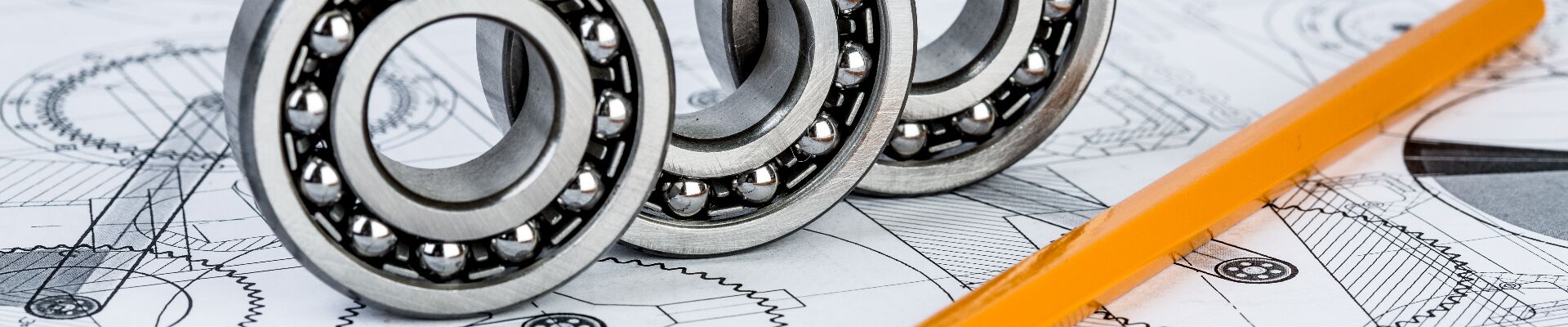
Miniature Crossed Roller Bearings
Miniature crossed roller bearings are widely used in machine tool turntables, medical devices, robotic arms, and rotating components of detection devices due to their small size, good operational stability, high rotational accuracy, and high rigidity. These mechanical components are characterized by frequent start-stop operations; therefore, studying the frictional torque characteristics of miniature crossed roller bearings is of great significance.
Structure of Miniature Crossed Roller Bearings
Miniature crossed roller bearings consist of two identical outer ring halves, an inner ring, rollers, and an integral cage. The two outer ring halves are connected by screws, and the rollers are spaced apart by cage pockets. Because adjacent rollers are arranged in a cross pattern, miniature crossed roller bearings can withstand axial loads, radial loads, and overturning moments. During operation, the outer ring is fixed, and the inner ring rotates.
Frictional Torque Characteristics of Miniature Crossed Roller Bearings
1) The frictional torque of miniature crossed roller bearings increases with increasing rotational speed and overturning moment. In turntable applications subjected to overturning moments, the operating conditions should be appropriately set to reduce the risk of increased bearing frictional torque.
2) For the same radial clearance, a larger overturning moment results in a larger bearing frictional torque. As the radial clearance increases, the bearing frictional torque tends to decrease, but it stabilizes when the radial clearance exceeds 5 μm. Considering operational stability, it is recommended to control the radial clearance between 5 and 10 μm.
3) The larger the absolute value of the raceway angle deviation, the more pronounced the off-center loading effect in the roller generatrix direction, leading to a more uneven pressure distribution and a larger bearing frictional torque. It is recommended to control the inner raceway angle deviation within ±2′ and the outer raceway angle deviation within ±1′ to reduce bearing frictional torque.
4) Logarithmically modified rollers provide lower frictional torque over a wider range of overturning moments. However, when the overturning moment approaches 400 N·m, the difference in effectiveness between end-rounded and logarithmically modified rollers in reducing bearing frictional torque is not significant. To reduce frictional torque, logarithmically modified rollers are recommended in bearing design.
5) The influence of the structural parameters of crossed roller bearings on frictional torque, from largest to smallest, is as follows: radial clearance, inner raceway angle deviation, upper outer ring raceway angle deviation, and lower outer ring raceway angle deviation. Therefore, the radial clearance of crossed roller bearings should be controlled first, followed by the raceway angle deviation, especially the inner raceway angle deviation, to improve the bearing's frictional torque performance.
Post time: Jul-08-2026


