


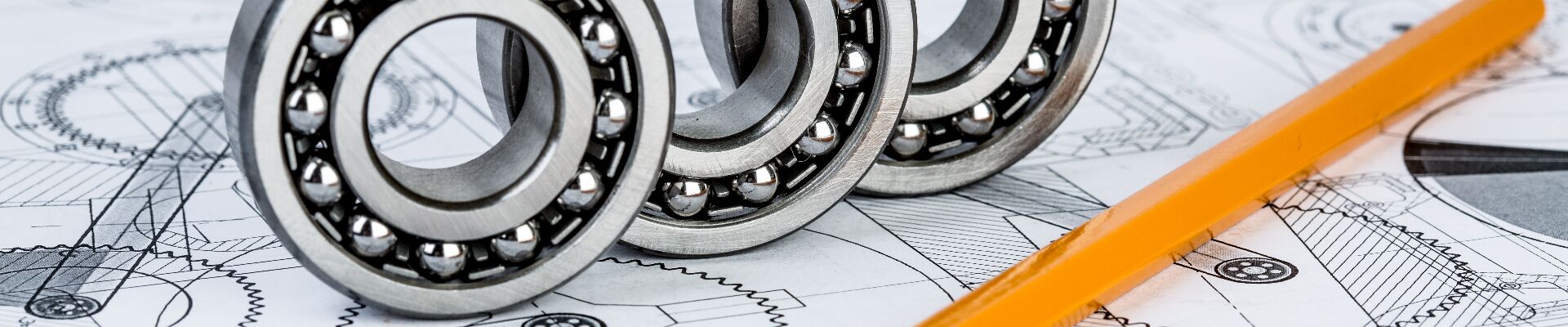
Spherical Roller Bearings: The Heavy-Duty Cornerstone for 'Misaligned Shafts'
In the world of heavy machinery operation, shaft bending or slight installation deviations are unavoidable pain points. Facing this 'eccentricity' crisis, spherical roller bearings, with their unique 'self-aligning' capability, have become crucial components for ensuring stable equipment operation.
Core Structure: Ingenious Coordination of Spherical Raceways and Barrel-Shaped Rollers
The 'superpower' of spherical roller bearings comes from their ingenious structural design. Their outer ring raceway is spherical, with the center of curvature aligned with the bearing axis, while the rolling elements are two rows of barrel-shaped rollers. This design allows the inner ring, rollers, and cage assembly to pivot freely based on the spherical center within a certain angle (typically 1° to 2.5°). When the shaft bends or tilts, the bearing can automatically adapt to this angular deviation, ensuring uniform load distribution and effectively preventing the stress concentration and early damage common in ordinary bearings.
Outstanding Performance: Heavy Load Resistance and Bi-Directional Carrying Capacity
In addition to excellent self-aligning performance, spherical roller bearings are truly 'load-bearing experts.' The two rows of barrel-shaped rollers make line contact with the raceways, resulting in a large contact area and extremely high radial load capacity for the same size. Additionally, they can withstand axial loads in both directions, making them especially suitable for harsh conditions involving high-frequency vibration and massive impact forces.
Applications and Limitations: Ideal for Medium-Low Speed Heavy Loads
Thanks to these advantages, spherical roller bearings are widely used in heavy equipment such as mining crushers, metallurgical rolling mills, paper-making machinery, wind turbine main shafts, and port cranes. They are ideal for handling complex loads and shaft misalignment. However, it should be noted that due to the large number of rollers and greater friction area, these bearings generate more heat at high speeds, so their maximum speed is relatively low. They are better suited for medium-low speed, heavy-duty conditions to achieve maximum efficiency.
Post time: Oct-21-2026


