


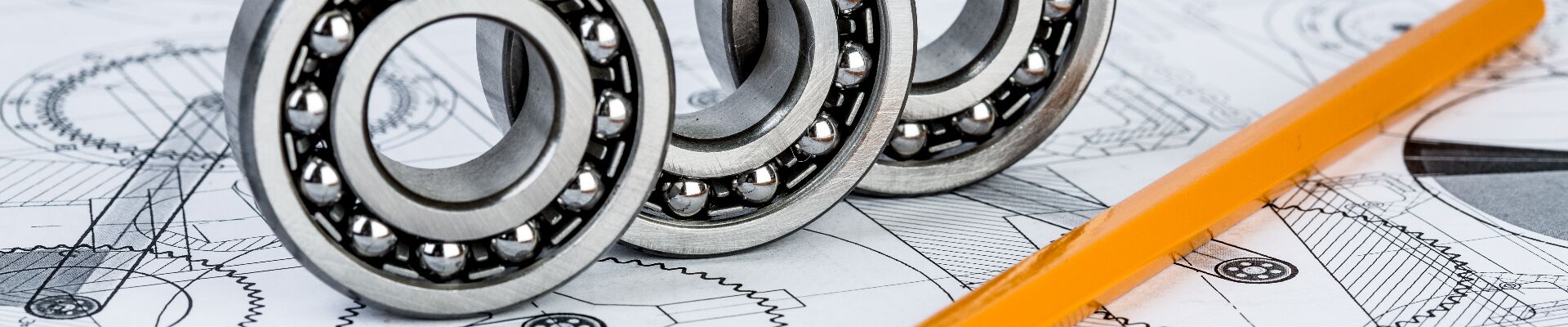
Aero engine bearings
Bearing type
The aero engine spindle speed is high, the hot end temperature is high, and the bearing needs to bear axial load and radial load, so the bearing is divided into two categories: thrust fulcrum bearing and swimming fulcrum bearing: thrust fulcrum bearing usually uses three-point angular contact ball bearing to bear axial load and control the axial clearance of the rotating stator; Traveling fulcrum bearings only bear radial loads, and because the rotor will move in the axial direction due to thermal expansion and contraction, cylindrical roller bearings with no borders on the outer or inner ring are usually used.
Aero engine accessory gearboxes are usually driven by spur gears, and the bearings only bear radial loads and the rotor thermal expansion is small, so cylindrical roller bearings and deep groove ball bearings are mainly selected.
The reducer gearbox transmits a large amount of power, some of which use helical gears, and the bearings need to bear both radial and axial loads, so cylindrical roller bearings, deep groove ball bearings and three-point angular contact ball bearings are mainly selected.
Aero engines use three-point angle contact ball bearings and cylindrical roller bearings.
Three-point angle contact ball bearings
When the aero engine is running, radial load and axial load will be generated on the spindle, and a set of ball bearings are generally set at the fulcrum point in front of the spindle to bear the radial load formed by the superposition of the unbalanced force of each shaft and high-speed rotation, and at the same time bear the difference axial load between the pneumatic force of the fan and compressor forward and the pneumatic force backward of the turbine.
Comparison of the structure of deep groove ball bearings and three-point angular contact ball bearings, the center of the inner ring groove of the three-point angular contact ball bearing is equipped with an axial eccentricity Lo, which makes its axial clearance Ga and the amount of rotor in the axial direction less and easier to control the axial clearance of the engine's rotating stover.
The three-point angular contact ball bearing has a double half-inner ring structure, and its semi-inner ring separable design allows for the installation of more balls, significantly increasing the bearing capacity.
Comparison of the structure of angular contact ball bearings and three-point angular contact ball bearings, angular contact ball bearings can only bear one-way axial loads, if they need to bear bidirectional axial loads, they need to be combined, which will take up more space and increase the mass; The double and half inner rings of three-point angular contact ball bearings can directly bear bidirectional axial loads, which can save about 50% of space and quality compared with double row or group of supporting angular contact ball bearings, and are easy to install, which is convenient for engine design.
The cage and ball assembly of the three-point angular contact ball bearing can be separated from the outer ring, so a one-piece solid cage can be used, which has higher strength, is suitable for high rotational speed, and is easier to obtain higher machining accuracy; At the same time, the structure also makes the installation and inspection of bearings more convenient.
Compared with ordinary mechanical cylindrical roller bearings, the roller diameter of aero engine cylindrical roller bearings is smaller, and its advantages are as follows:
1) It can reduce the oil stirring resistance of the roller during high-speed operation;
2) The inertial force is small;
3) Sufficient contact pressure can be maintained when the radial force is small to avoid roller slippage;
4) Since the ferrule, roller and cage components can be separated, a solid cage can be used, which has better strength and high-speed stability.
Cylindrical roller bearings with no flange in the inner ring usually have a larger inner ring width to accommodate the axial movement between the inner and outer rings caused by the elongation caused by thermal expansion between the shaft and the inner ring of the bearing, as well as the relative misalignment between the inner and outer rings caused by the axial assembly error of the rotor assembly during assembly. If the installation space is small or there are special requirements, the shaft or bearing housing can be directly used instead of the flangeless inner ring.
Aero engine cylindrical roller bearings often face the working conditions of small or no radial load of radial load, and the rotation speed is very high, the rollers are prone to slippage and rubbing, in order to prevent slippage, non-circular raceways are often used to realize the radial preload of the bearing, and the load distribution of two typical non-circular raceway bearings is often used.
Bearing material
The operating environment temperature of the engine turbine bearing is very high, and it is usually necessary to cool the bearing with a volume of lubricating oil of several liters per minute, but the working temperature of the bearing can still reach about 250 °C.
In order to meet the high temperature working conditions, the bearing ring usually uses 8Cr4Mo4V (M50) steel and other high-temperature bearing steel, and is treated with high temperature tempering, even if the bearing temperature reaches 400 °C after the engine is stopped, it can still ensure the performance of the bearing. In order to meet the rolling fatigue life, the surface hardness of the bearing material is generally required to be not less than 60 HRC at room temperature, and the overall 8Cr4Mo4V steel is hardened by heat treatment, but the toughness is lower than that of the structural component material, which will lead to the cracking of the ferrule when the centrifugal force of the ferrule and the circumferential stress of the shaft are large. Therefore, the dn value exceeds 2.5×106 mm · r/min bearings need to be made of G13Cr4Mo4Ni4V (M50NiL) material, which has better core toughness.
The cage material of aero engine bearings is generally made of structural steel such as 40CrNiMoA (4030), and the cage needs to be silver-plated to reduce wear during the start-up stage. The rolling element is the same as the ferrule material, and its hardness is generally the same as that of the ferrule, and in some cases it will be 1 ~ 2 HRC higher than the ferrule. Sometimes the ball also uses ceramic materials such as silicon nitride, alumina, and zirconia.
Post time: Jun-08-2026


