


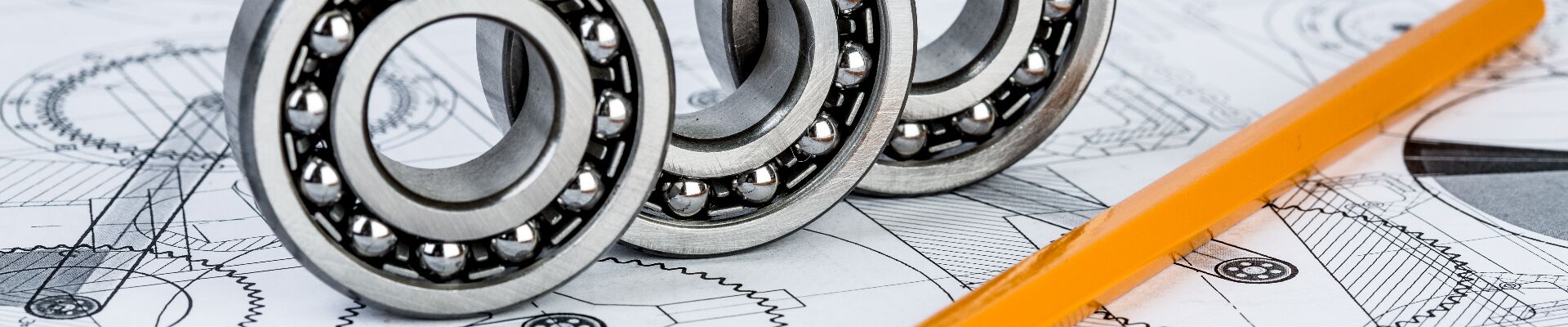
An assembly of a fully loaded needle roller/full thrust angular contact ball combination bearing
Needle roller bearings mainly bear radial loads, small radial size, high bearing capacity, compact structure, suitable for radial installation of mechanical parts with limited space;
Angular contact ball bearings are mainly subjected to radial loads, but also axial loads. NKIA series needle roller/angular contact ball combination bearings with both characteristics can bear radial heavy loads and axial light loads at the same time, with compact structure, small installation space, high rotation accuracy, and are widely used in machine tools, metallurgical machinery, textile machinery, printing machinery and other equipment.
The conventional NKIA series needle roller/angular contact ball combination bearings are a combination of needle roller bearings and angular contact ball bearings with a contact angle of 25°, which are usually assembled with rolling elements and cages after ferrule sorting, demagnetization, and cleaning. When the outer ring with double flange fully loaded needle roller bearings is manually assembled in small batches, it can be directly loaded into the needle roller, or the outer ring raceway can be coated with grease, the arranged needle rollers are glued into the outer ring, and then installed into the inner ring to complete the assembly; When assembling the inseparable full thrust angle contact ball bearing of the inner and outer rings, the large end of the inner ring is placed downwards, and the steel ball is directly loaded into the inner ring groove through the designed balling tooling, and then the small end face of the heating and expanding outer ring is placed downwards on the outside of the steel ball, and the appropriate axial force is applied to the large end face of the outer ring to make the outer ring and the inner ring and the ball combined, and the assembly can be completed.
With the development of aviation equipment in the direction of lightweight, thin-walled, high-precision, heavy-duty full loading needle roller/full loading thrust angle contact ball bearing came into being, a type of combined bearing for aviation is shown in Figure 1, composed of needle roller bearing and thrust angle contact ball bearing with a contact angle of 60°, inseparable at room temperature, the needle roller specification is Ф6.5 mm×25.8 mm, and the contact width between the outer ring flange and the needle roller end face is 1.02 mm. Due to the small contact area between the needle roller and the flange edge, if the needle roller is directly installed in the conventional way or the needle roller is glued into the outer ring groove by applying grease, due to the lack of cage limit, the needle roller is easy to skew and fall off when the subsequent vertical placement of the ball, and the assembly cannot be completed. Therefore, it is necessary to explore the assembly method of this type of bearing.
2 Assembly of fully loaded needle roller/fully loaded thrust angular contact ball combination bearing
2.1 Assembly principle
Combined with the structural characteristics of the bearing, it is necessary to complete the needle roller assembly first, and then the ball assembly. Due to the lack of cage limit, the needle roller is easy to fall off when assembled, so the mounting base that plays a fixed role when installing the needle roller is designed, and the needle roller is coated with lubricating oil (considering the convenience of subsequent cleaning, lubricating oil is selected instead of grease, the oil mainly plays an adsorption role, which can reduce the skew between the outer ring straight raceway and the steps of the fixed needle roller during the installation of the needle roller, and the actual operation can use lubricating oil and anti-rust oil can be used) and then installed into the outer ring straight raceway, the assembly principle is as shown in the figure.
Principle diagram of needle roller assembly

1—Outer ring; 2—Needle roller; 3—Mounting the base.
After the installation of the needle roller, the vertical placement needs to be fixed during subsequent balling, so the positioning mandrel that plays the role of fixing the needle roller is designed, and the fixing principle is shown in the figure.
Principle diagram of needle roller fixing

1—Positioning mandrel; 2—Needle roller; 3—outer ring; 4—Mounting the base.
icon download: original image | High Precision Picture | Low-precision map
According to the characteristics of the high flange structure of the bearing thrust ball, a special ball loading tooling is designed, which is based on the positioning of the outer diameter and end face, and at the same time to guide the steel ball to smoothly enter the outer ring arc channel, two slopes with different angles are designed, the principle is shown in the figure.
Design points of assembly tooling
Mounting base
The outer ring arc channel is installed downwards to install the needle roller, and the installation base is designed with 2 steps
Positioning mandrels
When loading balls, in order to realize the positioning of the outer ring, needle roller and inner ring, the positioning mandrel adopts a three-step structure.
Ball loading tooling
The inner diameter of the balling tooling is equipped with one step and two tapers: the step fixes the balling tooling on the small end face of the bearing, the large inner diameter surface and the outer ring of the bearing are clearance matching, the small inner diameter is equal to the diameter of the small flange of the outer ring, and the balling tooling is positioned on the small end face of the outer ring;
Assembly steps
When assembling, put the outer ring arc channel downwards into the mounting base, and then coat the needle roller with lubricating oil and install it into the outer ring straight raceway. After the needle roller installation is completed, the positioning mandrel is inserted into the mounting base, and then the tooling and bearing parts are turned over 180° as a whole, and the mounting base is taken out for steel ball assembly.
Post time: Jun-02-2026


