


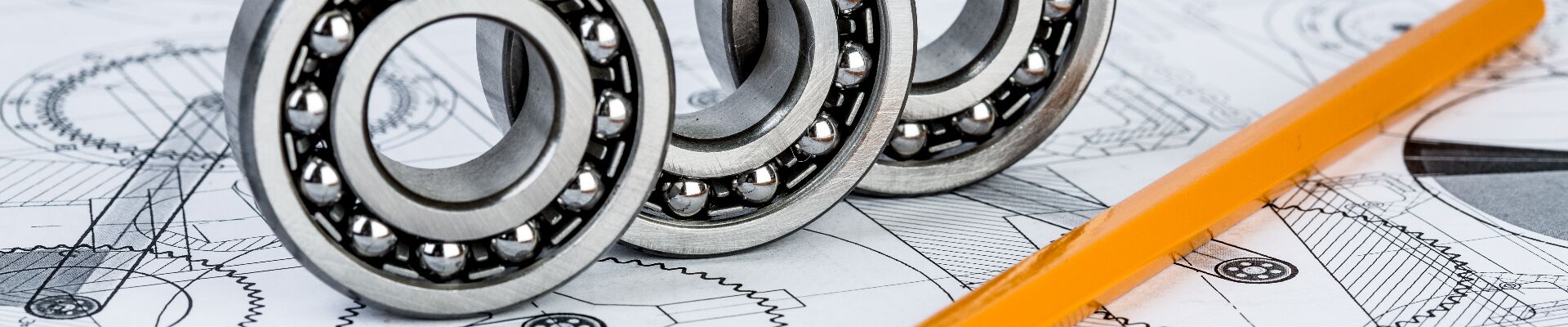
Assembly of Full complement needle roller/full complement thrust angular contact ball bearings
Needle roller bearings primarily bear radial loads, have small radial dimensions, high load-carrying capacity, and a compact structure, making them suitable for mechanical parts with limited radial installation space. Angular contact ball bearings primarily bear radial loads, but can also withstand axial loads. The NKIA series needle roller/angular contact ball bearings, combining the characteristics of both, can simultaneously withstand heavy radial loads and light axial loads. They have a compact structure, require little installation space, and offer high rotational accuracy, making them widely used in machine tools, metallurgical machinery, textile machinery, and printing machinery.
A typical NKIA series needle roller/angular contact ball bearing consists of a needle roller bearing and an angular contact ball bearing with a 25° contact angle. These bearings are typically assembled with the rolling elements and cage after the rings have been sorted, demagnetized, and cleaned. For small-batch manual assembly of full complement needle roller bearings with double flanges on the outer ring, the needle rollers can be directly installed, or grease can be applied to the outer ring raceway, the arranged needle rollers can be glued into the outer ring, and then the inner ring can be installed to complete the assembly. For assembly of full complement thrust angular contact ball bearings where the inner and outer rings are inseparable, first place the inner ring with its large end face down, and use a designed ball-loading fixture to directly install the steel balls into the inner ring raceway. Then place the heated and expanded outer ring with its small end face down outside the steel balls, and apply a suitable axial force to the large end face of the outer ring to assemble the outer ring, inner ring, and balls, thus completing the assembly.
Assembly Principle of Full Compact Needle Roller/Full Compact Thrust Angular Contact Ball Combination Bearings
Due to the structural characteristics of this bearing, the needle roller assembly must be completed first, followed by the ball assembly. Because of the lack of a cage for restraint, the needle rollers are prone to skewing and falling off during assembly. Therefore, a mounting base was designed to fix the needle rollers during installation. The needle rollers are coated with lubricating oil (for ease of subsequent cleaning, lubricating oil is used instead of grease; the oil mainly acts as an absorbent, reducing skewing between the outer ring raceway and the step where the needle rollers are fixed during installation; in practice, either lubricating oil or rust-preventive oil can be used) before being installed into the outer ring raceway.
After the needle rollers are installed, they need to be fixed in place when loading balls. Therefore, a positioning mandrel was designed to fix the needle rollers.
Based on the high flange structure of the thrust balls in this bearing, a special ball loading fixture was designed. This fixture is positioned based on the outer diameter surface and end face. To guide the steel balls smoothly into the outer ring's arc groove, two ramps with different angles were designed.
With the development of lightweight aerospace equipment, thin-walled, high-precision, heavy-load full complement needle roller/full complement thrust angular contact ball bearings have emerged. When using conventional assembly methods to directly install the needle rollers or apply grease to glue them into the outer ring raceway, the lack of cage restraints makes it easy for the needle rollers to skew and fall off during subsequent vertical ball loading. Therefore, an assembly fixture including a mounting base, a positioning mandrel, and a ball loading fixture was designed. First, the mounting base is used to install the needle rollers, then the positioning mandrel fixes the installed needle rollers. Next, the ball loading fixture is used to install the steel balls, and finally, the outer ring is heated and pressed into the inner ring. The radial clearance, dimensions, and rotational accuracy of the assembled bearing all meet the design requirements.
Post time: Jul-06-2026


