


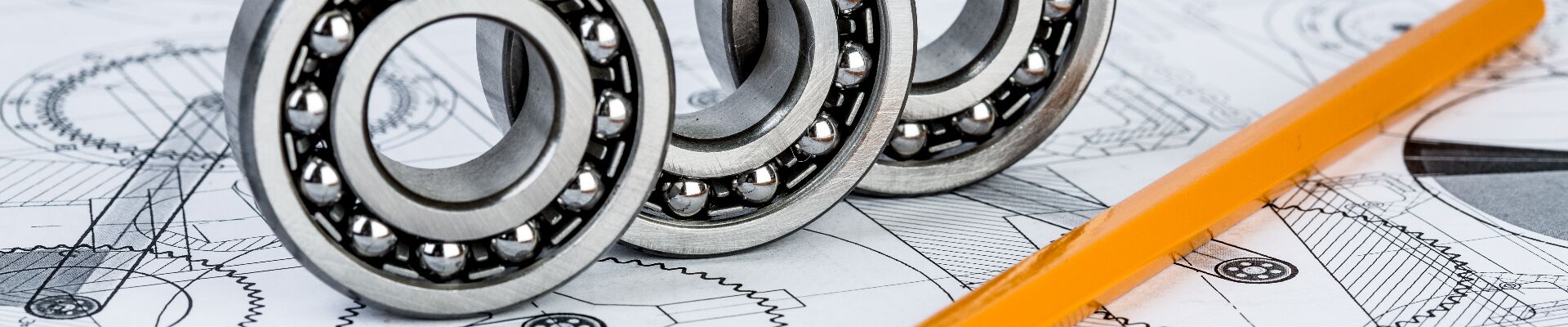
Bearing Selection: Four Core Performance Dimensions
In practical mechanical design and equipment maintenance, many engineers often face a dilemma when confronted with a vast array of bearing models. Choosing the right bearing is not about blindly pursuing high specifications, but rather about precise matching based on operating conditions. This article will provide an in-depth analysis of bearing performance differences from four core dimensions: load capacity, speed, rigidity, and environmental adaptability.
Load Capacity: The Physical Game Between Point Contact and Line Contact
The load capacity of a bearing primarily depends on the direction of the force and the structure of its rolling elements. Radial bearings (such as deep groove ball bearings and cylindrical roller bearings) are the main force for radial loads, while thrust bearings (such as thrust ball bearings) are dedicated to pure axial loads. When equipment faces combined radial and axial forces, angular contact ball bearings and tapered roller bearings become the preferred choice, as their specific contact angle design perfectly mitigates combined loads.
Within the same external dimensions, the shape of the rolling elements directly determines the upper limit of the load capacity. Ball bearings, with their point-contact structure, exhibit low frictional resistance, making them suitable for light to medium loads. Roller bearings, on the other hand, utilize a line-contact design, resulting in significantly higher rated dynamic and static loads, making them the primary choice for heavy-load and high-impact applications.
Speed Limits: Balancing Centrifugal Force and Frictional Heat
Every bearing has its "speed ceiling," its limiting speed. In high-speed applications, deep groove ball bearings and angular contact ball bearings are undoubtedly the "champions." This is due to the physical advantages of their lightweight balls and low centrifugal force; their limiting speeds are typically more than 1.5 times that of roller bearings of the same size.
In contrast, thrust bearings, due to their structural characteristics, generally have lower limiting speeds and must not be used excessively at high speeds. When the operating speed approaches its limit, the frictional heat generated inside the bearing increases exponentially. At this point, engineers must comprehensively consider the coefficient of friction and heat dissipation conditions, and, if necessary, introduce ceramic hybrid bearings or forced cooling systems to overcome the speed bottleneck.
Rigidity and Precision: The Stabilizing Force of Precision Equipment
For precision equipment such as machine tool spindles, bearing rigidity (resistance to elastic deformation) is crucial. Roller bearings, with their inherent advantage of line contact, offer significantly superior contact stiffness compared to ball bearings. Furthermore, by applying preload, angular contact ball bearings and tapered roller bearings can eliminate internal clearance, greatly enhancing the rigidity of the entire shaft system—a standard feature of high-precision machine tool spindles.
In precision selection, the principle of "matching as needed" must be followed. From standard grade (P0) to ultra-precision grade (P4, P2), the manufacturing cost increases exponentially with each increase in precision. For general transmissions, P0 grade is sufficient; however, for high-speed, high-rotational-precision applications, P5 or P4 grade bearings must be selected to ensure extremely low runout errors.
Environmental Adaptability and Operational Quality: Self-aligning, Quiet Operation, and Low Friction
Actual operating conditions often involve installation errors and shaft deformation. At this point, self-aligning ball bearings and self-aligning roller bearings demonstrate their "all-purpose" advantage, automatically compensating for axial misalignment and effectively preventing premature failure caused by edge stress concentration. Rigid bearings such as cylindrical roller bearings are extremely sensitive to angular misalignment, requiring extremely high coaxiality during installation.
In terms of operational quality, deep groove ball bearings, with their extremely low coefficient of friction (approximately 0.0015~0.0022), are considered "silent champions" in household appliances and noise-reducing equipment. Conversely, roller bearings, due to their large contact area, typically have higher operating noise. Furthermore, low-friction design not only reduces noise but also reduces energy consumption by up to 30%, a significant energy-saving benefit for large, continuously operating equipment.
Bearing selection is essentially a multi-dimensional performance trade-off. Clearly defining the core requirements of the equipment—whether it's pursuing maximum speed and withstanding heavy load impacts, or requiring high rigidity and low noise—and then matching these against the aforementioned performance dimensions, will allow you to find the most suitable "chosen one" for the operating conditions, thereby avoiding unplanned downtime and maximizing equipment efficiency.
Post time: Aug-17-2026


