


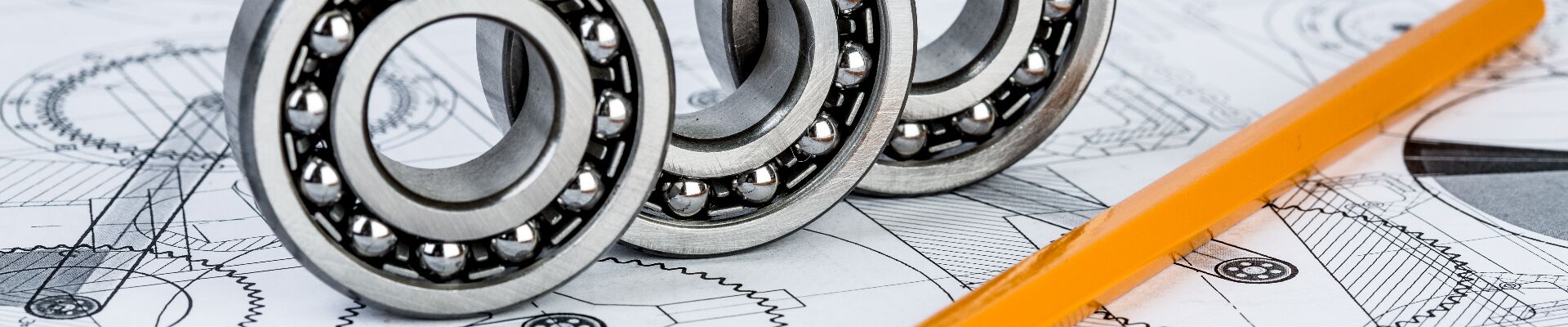
Bearing Selection Quick Reference Guide
In mechanical transmission systems, accurate bearing selection directly affects the service life and stability of the equipment. Faced with a complex array of bearing types and parameters, mastering the core selection logic is more crucial than rote memorization of size tables.
1. Common Bearing Types and Working Condition Matching
The internal structure of different bearings determines their stress characteristics. When selecting a bearing, it is essential to first clarify the direction of force and the speed requirements of the equipment:
Deep Groove Ball Bearings (Type 6): As the most widely used general-purpose bearing, they are designed for high speed and light loads, capable of simultaneously withstanding radial and a small amount of axial force. The 60 series is suitable for light and thin applications, the 62 series is the standard general-purpose first choice, and the 63 series is specifically designed for heavy loads with added thickness.
Angular Contact Ball Bearings (Type 7): Designed for complex loads, commonly used in machine tool spindles and ball screws. Note that they must be installed in pairs (back-to-back or face-to-face) to counteract axial forces.
Taper Roller Bearings (Type 3): Possessing extremely high load-bearing capacity and impact resistance, suitable for low-speed, heavy-load transmission equipment such as gear shafts in reducers.
Thrust ball bearings (Class 5): Specifically designed for purely axial load conditions such as vertical lifting shafts or top clamping; radial forces are strictly prohibited.
Self-aligning ball bearings: Features automatic alignment, suitable for long drive shafts or equipment with poor alignment.
2. Core Performance Parameters and Life Assessment
The inner diameter (d), outer diameter (D), and width (B) in the bearing size table only determine the installation space. True performance assessment relies on the following parameters:
Rated dynamic/static load: The rated dynamic load (Cr) is a model indicator based on a 1 million revolutions lifespan. If the actual load exceeds this value, the lifespan will shorten exponentially. The rated static load (Cor) determines the bearing's resistance to plastic deformation at rest or very low speeds.
Limiting speed: Due to low point contact friction, the limiting speed of ball bearings is typically 1.5 times higher than that of roller bearings of the same size. If the operating speed approaches the limiting value, the heat dissipation and lubrication methods must be carefully evaluated.
Safety Factor: 1.2~1.5 for normal intermittent operation; 1.8~2.2 for continuous 24-hour operation; 2.5~3.5 for impact loads or frequent start-stop operations.
3. Selection and Suffix Identification
In actual procurement and replacement, special attention should be paid to the additional attributes represented by the model suffix.
Sealing Type: 2Z indicates double-sided dust cover (dustproof but not waterproof); 2RS indicates double-sided rubber seal (waterproof and oil-proof, suitable for outdoor or humid environments).
Clearance and Precision: C3 indicates large clearance, specifically designed to compensate for the high-temperature thermal expansion of motors and other equipment; suffixes such as P5/P4 represent high precision levels, suitable for precision machine tools.
Common Misconceptions: Do not use only deep groove ball bearings when axial force is too large, as this can easily lead to axial movement and damage; if both ends of a long drive shaft are rigidly locked, thermal expansion will cause the bearings to seize and overheat; in harsh dusty environments, failure to use sealed bearings will lead to rapid wear.
Post time: Sep-18-2026


