


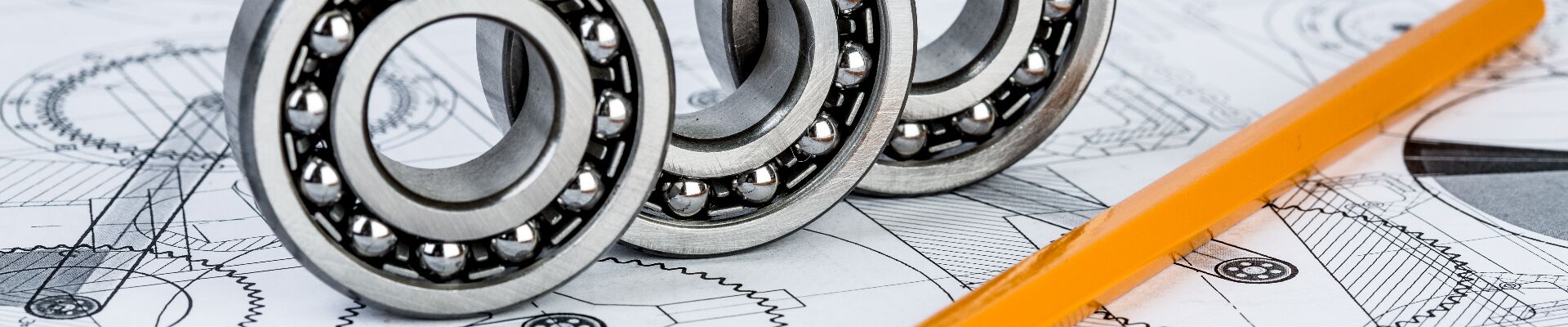
Characteristics, differences and uses of fourteen types of bearings
Bearings are important components in mechanical equipment. Its main function is to support the mechanical rotating body to reduce the mechanical load friction coefficient of the equipment during transmission. Bearings are divided into centripetal bearings and thrust bearings according to different bearing directions or nominal contact angles. According to the type of rolling element, it is divided into: ball bearing, roller bearing. According to whether it can be aligned, it is divided into: aligning bearings, non-aligning bearings (rigid bearings). According to the number of columns of the rolling element, it is divided into: single-row bearing, double-row bearing, and multi-row bearing. According to whether the parts can be separated, it is divided into: separable bearings and non-separable bearings. In addition, there is a classification by structure shape and size. This article mainly shares the characteristics, differences and corresponding uses of 14 common bearings.
1. Angular contact ball bearing
There is a contact angle between the ferrule and the ball, the standard contact angle is 15°, 30° and 40°, the larger the contact angle, the greater the axial load capacity, the smaller the contact angle, the more conducive to high-speed rotation, the single row bearing can withstand radial load and unidirectional axial load. Structurally, the two single-row angular contact ball bearings combined on the back side share the inner ring and the outer ring, which can withstand radial and bidirectional axial loads.
Main uses:
Single row: machine tool spindle, high-frequency motor, gas turbine, centrifugal separator, small car front wheel, differential pinion shaft.
Double row: oil pump, roots blower, air compressor, various transmissions, fuel injection pumps, printing machinery.
2.Spherical ball bearing
Double row steel balls, the outer ring raceway is of the inner spherical type, so it can automatically adjust the shaft misalignment caused by the deflection or uncenteredness of the shaft or housing, and the tapered bore bearing can be easily installed on the shaft by using fasteners, mainly bearing radial loads.
Main uses: woodworking machinery, textile machinery drive shafts, vertical belt seat spherical bearings.
This type of bearing is equipped with spherical rollers between the outer ring of the spherical raceway and the inner ring of the double raceway, according to the different internal structures, divided into four types: R, RH, RHA and SR, because the arc center of the outer ring raceway is consistent with the bearing center, with aligning performance, so it can automatically adjust the shaft incorrect caused by the deflection or uncentering of the shaft or shell, and can withstand radial load and bidirectional axial load.
Main uses: paper making machinery, reduction devices, railway vehicle axles, rolling mill gearbox seats, rolling mill roller passers, crushers, vibrating screens, printing machinery, woodworking machinery, various industrial reducers, vertical spherical bearings.
4. Thrust spherical roller bearing
The spherical rollers in this type of bearing are tilted in an inclined arrangement, because the raceway surface of the race is spherical, with coherent performance, so the shaft can be allowed to have a number of inclinations, the axial load capacity is very large, and it can bear a number of radial loads while bearing the axial load, and it is generally lubricated with oil when used.
Main uses: hydroelectric generators, vertical motors, propeller shafts for ships, reducers for rolling screws, tower cranes, coal mills, extruders, forming machines.
This type of bearing is equipped with round trap rollers, which are guided by the large flange of the inner ring, and the design makes the vertices of the inner raceway surface, the outer ring raceway surface and the conical surface of the roller rolling surface intersect at a point on the center line of the bearing. Single-row bearings can withstand radial loads and unidirectional axial loads, and double-row bearings can bear radial loads and bidirectional axial loads, and are suitable for bearing heavy loads and shock loads.
Main uses: automobiles: front wheels, rear wheels, transmissions, differential pinion shafts. Machine tool spindles, construction machinery, large agricultural machinery, railway vehicle gear reduction devices, rolling mill roller necks and reduction devices.
Structurally, each ferrule of a deep groove ball bearing has a continuous groove-type raceway with a cross-section of approximately one-third of the circumference of the ball's equatorial circle. Deep groove ball bearings are mainly used to bear radial loads, but also can bear certain axial loads.
When the radial clearance of the bearing increases, it has the property of angular contact ball bearings and can withstand axial loads that alternate in both directions. Compared with other types of bearings of the same size, this type of bearing has a small friction coefficient, high ultimate speed and high precision, and is the preferred bearing type for users when selecting a model.
Main uses: automobiles, tractors, machine tools, motors, water pumps, agricultural machinery, textile machinery, etc.
It is composed of a washer-shaped raceway ring with a raceway and a ball and cage assembly, and the raceway ring that matches the shaft is called the shaft ring, and the raceway ring that matches the housing is called the seat. The bidirectional bearing is matched with the middle circle secret shaft, the unidirectional bearing can bear the unidirectional axial load, and the bidirectional bearing can bear the bidirectional axial load (neither can bear the radial load).
Main uses: automobile steering pins, machine tool spindles.
Thrust roller bearings are used to bear axial load-based shafts, meridional combined loads, but the warpstroke load shall not exceed 55% of the axial load. Compared with other thrust roller bearings, this type of bearing has a lower coefficient of friction, higher rotational speed, and has the ability to align. The rollers of the 29000 bearing are asymmetrical spherical rollers, which can reduce the relative sliding of the rod and raceway in the work, and the rollers are long, the diameter is large, the number of rollers is large and the load capacity is large, usually lubricated with oil, and some low-speed situations can be lubricated with grease.
Main uses: hydroelectric generators, crane hooks.
9. Cylindrical roller bearings
The rollers of cylindrical roller bearings are usually guided by two flanges of a bearing ferrule, keeping? The frame roller and guide ferrule form an assembly that can be separated from another bearing ferrule and is a separable bearing.
This kind of bearing installation is more convenient to disassemble, especially when the inner and outer rings are required to be interference with the shaft and shell. This type of bearing is generally only used to bear radial loads, and only single-row bearings with flanges on both the inner and outer rings can bear small constant axial loads or large intermittent axial loads.
Main uses: large motors, machine tool spindles, axle axle boxes, diesel engine crankshafts, automobiles, transformers of supporters, etc.
10. Four-point contact ball bearing
It can withstand radial load and bidirectional axial load, and a single bearing can replace the angular contact ball bearing of the front combination or the back combination, which is suitable for bearing pure axial load or synthetic load with a large axial load component, and this type of bearing can form one of the contact angles when bearing axial load in any direction, so the ferrule and the ball are always in contact with the two sides of the three-knife point on any contact line.
Main uses: aircraft jet engines, steam turbines.
11. Thrust cylindrical roller bearing
It consists of a washer-shaped raceway ring (shaft ring, seat ring) with cylindrical rollers and cage components. The cylindrical rollers are processed with convex surfaces, so the pressure between the rollers and the raceway surface is evenly distributed, and it can withstand unidirectional axial loads, with large axial load capacity and strong axial rigidity.
Main uses: oil drilling rigs, steelmaking and steelmaking machinery.
12. Thrust needle roller bearing
Separated bearings consist of raceway rings with needle rollers and cage assemblies, and can be combined with stamped thin raceway rings or cut thick raceway rings. Non-separable bearing is a monolithic bearing composed of raceway rings and needle rollers and cage components that have been precisely stamped, which can bear unidirectional axial loads, which occupies a small space and is conducive to the compact design of machinery.
Main uses: speed variable devices for automobiles, cultivators, machine tools, etc.
13. Thrust tapered roller bearing
This type of bearing is equipped with a round trapezoidal roller (the large end is spherical), the roller is accurately guided by the raceway ring (shaft, seat) flange, the design makes the shaft and the raceway surface of the raceway and the vertices of each conical surface of the roller roller surface intersect at a point on the center line of the bearing, the one-way bearing can bear the one-way axial load, and the two-way bearing can bear the two-way axial load.
Main uses:
One-way: crane hook, oil rig swivel ring.
Bidirectional: rolling mill roller neck.
14. Spherical ball bearing with seat outer sphere
Spherical ball bearings with seats consist of sealed spherical ball bearings on both sides and cast (or plate stamped) housings. The internal structure of the spherical ball bearing is the same as that of the deep groove ball bearing, but the inner ring of this bearing is wider than the outer ring, and the outer ring has a truncated spherical outer surface, which can be automatically adjusted to match the concave spherical surface of the bearing housing.
Main uses: mining, metallurgy, agriculture, chemical industry, textile, printing and dyeing. conveying machinery, etc.
Post time: Apr-20-2026


