


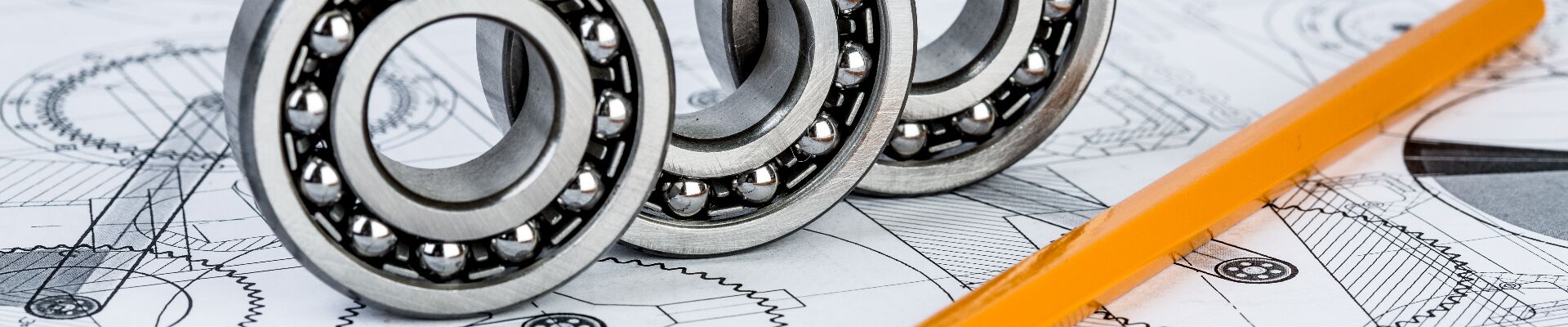
Characteristics of , what is thin section bearing?
Thin-section bearings have an extremely thin bearing section, which enables miniaturization and lightweight products, and expands the range of applications. According to their different sealing methods, thin-section bearings are generally divided into: rubber seal-RS, iron seal-ZZ, flat surface, iron card-K, copper card-M, etc.
In order to obtain the low friction torque, high rigidity and good rotational accuracy of thin-walled bearings, thin-walled bearings use steel balls with small outer diameters, and the use of hollow shafts also ensures lightweight and wiring space. In order to make the bearing play its function normally, in terms of lubrication, thin-section bearings generally use grease lubrication and oil lubrication, the purpose is to reduce the internal friction and wear of the bearing, prevent the bearing from overheating, and also prevent foreign objects from invading the bearing inside, or prevent rust and corrosion, so as to extend the service life of the bearing. During use, the rolling contact surface is well lubricated, which will extend the life; On the contrary, if the oil viscosity is low and the lubricating oil film thickness is not good, the life will be shortened.
The precision required for thin-walled ball bearings is very high, because its wall is very thin, so the weight it can bear is also very low, and the impact resistance is very poor, so this should be selected according to the use environment!
Thin-walled ball bearings have a simple structure and are easy to use. It is mainly used to bear radial loads, but when the radial clearance of the bearing is increased, it has a certain performance of angular contact ball bearings, and can withstand the combined radial and axial loads. When the rotational speed is high and it is not suitable to use thrust ball bearings, it can also be used to bear pure axial loads. Compared with other types of bearings of the same size, this type of bearing has a small friction coefficient and a high speed limit. However, it is not resistant to impact and is not suitable for bearing heavy loads. Equal section thin section bearing is a kind of bearing with special cross-section width and thickness; The same cross-sectional size can match many different bearing inner diameters; Compared to standard bearings, the width and thickness increase proportionally with the increase in the inner diameter of the bearing, while equal-section thin-section bearings increase the inner diameter and keep the cross-sectional size unchanged.
The combination of the nine section sizes (from 3/16" to 1") and bore sizes (from 1" to 40") of the thin section bearing range will result in many "thin" standard bearings with small sections and large bores. Thin section bearing materials 52100 chrome steel and 440C stainless steel can also be thin chrome plated. Many models can be equipped with seals or dust covers. There are three different types of thin section bearings: deep groove ball bearings, angular contact ball bearings, and four-point contact ball bearings. Compared to standard bearings, thin-section bearings can optimize system design more efficiently and reduce total costs. These three construction types, combined with different rollers and different cage types, allow the creation of a wide range of thin section bearing products based on limited cross-sectional sizes. Since the cross-sectional size of thin-walled shafts does not change with the inner diameter, the installation space requirements remain the same, only the weight changes slightly with the change of inner diameter.
Especially in medical devices, optical equipment, infrared scanning equipment, robots, and other fields, installation space and weight are factors to consider in terms of overall design and manufacturing costs. In many cases, even though the market price of thin-section bearings is higher than standard bearings with similar bore sizes, thin-section bearings can reduce installation space and weight, which can lead to significant cost savings in system design and application.

Post time: Apr-17-2026


