


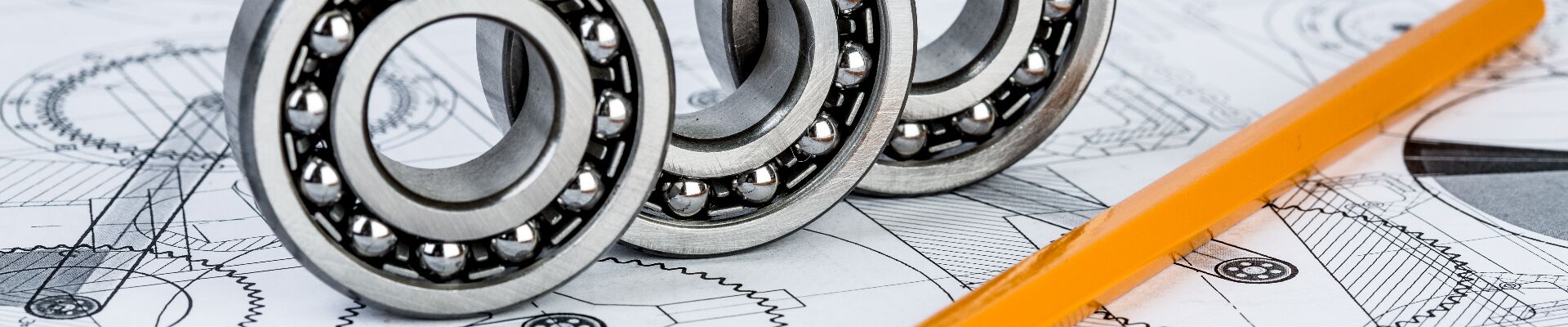
Differences between Vibration Bearings and Ordinary Bearings
1. Appearance Characteristics
A. Increased rolling element diameter and length.
B. Cage guides the rollers with outer ring flanges, reducing the force on the rollers.
C. Inner ring flanges guide the rollers, improving roller operation.
D. Cylindrical roller bearing cages use an integral structure, greatly increasing strength.
E. Self-aligning bearings have oil grooves and holes in the outer diameter for good lubrication.
Ordinary Bearings:
A. Smaller roller diameter and rolling element length.
B. Cage guided by rollers or inner ring.
C. Cylindrical roller bearing cages use a riveted structure, prone to loosening and cap loss.
D. Self-aligning bearings lack oil grooves and holes in the outer diameter, resulting in poor lubrication.
2. Material Selection
Vibration-Specific Bearings:
A. Inner and outer rings and rolling elements are made of vacuum-degassed bearing steel, offering good fatigue resistance.
B. The cage is made of aluminum-iron-manganese bronze, offering high strength, good elasticity, and superior wear resistance.
Ordinary Bearings:
A. Inner and outer rings and rolling elements are made of ordinary bearing steel.
B. The cage is made of zinc brass, resulting in low strength and poor elasticity.
3. Heat Treatment
A. Inner and outer rings undergo Beyer-Martens mixed quenching or martensitic quenching + high-temperature tempering, resulting in uniform hardness, low internal stress, good toughness, and resistance to impact and vibration.
B. Good stability when operating below 150°C.
Ordinary Bearings: Inner and outer rings undergo ordinary quenching, resulting in poor toughness, poor impact and vibration resistance, and poor thermal stability.
4. Tolerances and Manufacturing Process
Vibration-Specific Bearings:
A. Manufactured strictly according to P6 grade precision standards, especially with very small tolerances for inner and outer diameters.
B. Rolling element dimensional differences ≤0.002mm.
C. Cylindrical rollers have a convex outer diameter to avoid stress concentration.
D. Rolling surfaces undergo ultra-precision treatment for high smoothness.
Standard Bearings:
A. Manufactured to standard PO grade precision tolerances (some to P6 grade standards).
B. Rolling element grouping ≤0.005.
C. Cylindrical rollers without crown finishing.
D. Some raceways are only polished, resulting in low surface finish.
5. Internal Clearance
Vibration-Specific Bearings: Clearance is manufactured according to the requirements of vibrating machinery, with a very small range and good consistency.
Standard Bearings: Clearance is generally manufactured according to standard groups or C3 groups, with either small or large ranges and high dispersion.
6. Performance
Vibration-Specific Bearings: Low noise, low temperature rise, good stability, long service life, and no early fatigue.
Standard Bearings: High noise, high temperature rise, poor stability, short service life, and early fatigue.
Post time: Jul-24-2026


