


Introduction to Bearings and Working Conditions of Steel Balls
Rolling bearings are one of the essential standard components in the machinery industry. Rolling bearings are mass-produced by specialized bearing manufacturers. Users only need to select the appropriate bearing type and size based on specific working conditions, calculate the bearing's load-bearing capacity, and design the bearing's assembly structure (addressing issues such as bearing positioning, assembly/disassembly, adjustment, lubrication, and sealing).
Rolling bearings rely on the rolling contact between components to bear loads.
Compared to sliding bearings, rolling bearings have advantages such as low frictional resistance, high efficiency, easy starting, and simple installation and maintenance.
Disadvantages include poor impact resistance, short lifespan under high-speed and heavy loads, and higher noise and vibration.
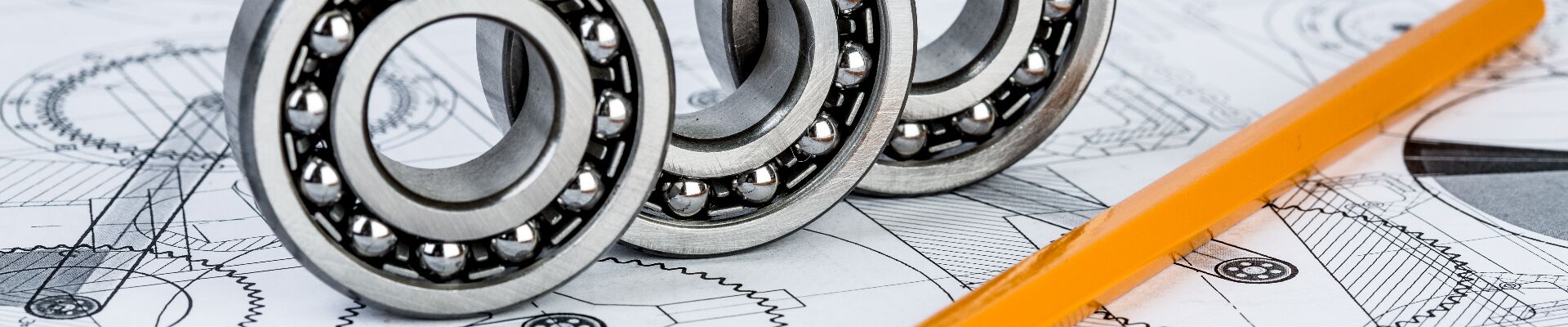
The basic structure of a rolling bearing consists of four parts: inner ring, outer ring, rolling elements, and cage.
Commonly used rolling elements include balls, cylindrical rollers, needle rollers, and tapered rollers.
The inner and outer rings and rolling elements of the bearing are generally made of bearing steel (such as GCr15, GCr15SiMn), and the hardness after heat treatment should reach 61–65 HRC.
Cages come in two structures: stamped and solid. Stamped cages are generally made of low-carbon steel sheet, resulting in a larger gap between the cage and the rolling elements, leading to higher noise levels during operation. Solid cages are commonly made of copper alloys, aluminum alloys, or polymer materials such as phenolic resin, providing better isolation and centering.
When the rolling elements are cylindrical or needle rollers, sometimes the inner ring, outer ring, or cage can be omitted to reduce the radial dimension of the bearing. In this case, the journal or bearing housing must function as the inner or outer ring. To meet certain usage requirements, some bearings have additional special structures or components, such as a retaining ring on the outer ring or an additional dust cover.
The working conditions of rolling bearings are extremely complex, subjecting to various high alternating stresses. A simple analysis is given using a single-row radial rolling bearing as an example.
At any given moment, only the balls located below the bearing's horizontal diameter bear the load, and the load distribution on these balls is uneven. It is generally assumed that the distribution of the force F acting on the balls follows the cosine theorem, i.e., F = Qcosθ. Therefore, the balls, directly below the force Q, bear the greatest load. When the bearing operates at high speed, the balls and raceway surfaces alternately bear the load. The force changes from zero to maximum, then from maximum to zero, cyclically increasing and decreasing. Thus, the inner and outer rings and rolling elements of a rolling bearing operate under alternating contact stress. Theoretically, the rolling elements and raceways of the bearing components have point (ball) or line (roller) contact, but in reality, under load, due to the elastic deformation of the metal, the stress often concentrates on a very small surface, with the maximum contact stress reaching 3000-5000 MPa. During operation, in addition to the external load, the balls are also subjected to loads caused by centrifugal force, which increases with the bearing speed.
There is also relative sliding between the rolling elements and the raceways and cage, generating relative friction. The working surfaces of the rolling elements and raceways are also subject to chemical corrosion from lubricating oil containing moisture or impurities. In addition, bearings in various vehicles, rolling mills, mining machinery and various other machines are subjected to complex torsional or impact loads and vibrations during operation. In some cases, bearings are also subjected to the effects of high and low temperatures and highly corrosive media.
Post time: Sep-07-2026


