


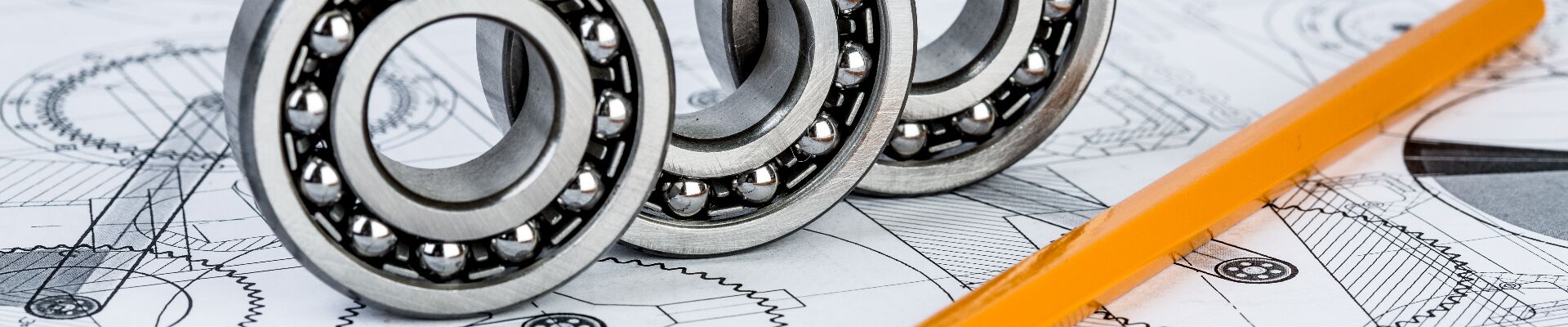
Key Points and Characteristics of Ball Screw Bearing Selection
Ball screw bearings are commonly used in machine tools. The appropriate type can be selected based on the application. To adapt to various applications, ball screw bearings offer a wide variety of standardized products. Ball circulation methods include circulation guide type, circulator type, and end cap type. Preload methods include positioning preload (double nut type, positional preload type) and constant pressure preload.
Key points for ball screw bearing selection:
1. Determine the diameter based on the load. The motor performance parameters include output torque; if a reducer is included, this should also be taken into account.
2. Determine the ball screw bearing lead based on linear speed and rotational speed. Once the motor is determined, the output speed is known. Consider the maximum linear speed you need. Multiply the motor speed (divide by the reduction ratio if a reducer is included) by the ball screw bearing lead to get the linear speed. This value should be greater than the required value.
3. Determine the ball screw bearing length based on actual needs. Total length = working stroke + nut length + safety margin + installation length + connection length + margin. If additional protection is added, such as a protective sleeve, the sleeve's elongation ratio (generally 1:8, i.e., the maximum elongation of the sleeve divided by 8) needs to be taken into account.
4. Determine the ball screw bearing precision based on actual needs. For general machinery, C7 or lower is sufficient; for CNC machine tools, C5 is more common (corresponding to domestic standards generally P5~P4 and P4~P3 grades).
5. Determine the ball screw bearing nut type based on installation conditions and structural dimensions. Nuts have many structures, and different nut structures have slightly different dimensions. Choose according to the situation; it is recommended not to choose overly specialized ones, as repairs and replacements may be difficult if problems arise.
6. Select and determine the installation method (end).
7. Consider guide components and installation capacity.
It is recommended to choose ball linear guides for the guide components used with ball screw bearings. Of course, the combination of linear shafts and linear bearings is a relatively economical choice.
The characteristics of ball screw support bearings include:
1. High transmission efficiency: The transmission efficiency of ball screw transmission systems reaches 90%~98%, which is 2~4 times that of traditional sliding screw systems. Therefore, it can obtain a large thrust with a small torque and can also convert linear motion into rotary motion (reversible motion).
2. Smooth motion: The ball screw transmission system uses point contact rolling motion, resulting in low frictional resistance, high sensitivity, no chattering during startup, and no crawling at low speeds. Therefore, it can precisely control micro-feed.
3. High precision: The ball screw transmission system experiences minimal temperature rise during operation and can be pre-tensioned to eliminate axial backlash and pre-stretched to compensate for thermal expansion, thus achieving high positioning accuracy and repeatability.
4. High durability: The rolling contact points of the steel balls are hardened (HRC58~63) and precision ground. The circulation process is purely rolling, with minimal relative wear, resulting in a long service life and high precision retention. 5. Excellent Synchronization: Due to its smooth movement, sensitive response, lack of obstruction, and slippage, several identical ball screw drive systems can simultaneously drive several identical components or devices, achieving excellent synchronization.
6. High Reliability: Compared to other transmission machinery and hydraulic transmissions, ball screw drive systems have a very low failure rate and are simpler to maintain, requiring only general lubrication and dust prevention. In special applications, they can operate without lubrication.
7. Zero Backlash and High Rigidity: The ball screw drive system uses a Gothic arch groove shape, ensuring optimal contact between the balls and the grooves for easy operation. Applying appropriate preload eliminates axial backlash, further enhancing ball rigidity and reducing elastic deformation between the balls, nut, and screw, resulting in higher precision.
8. Non-Self-Locking, Reversible Transmission: Reversible rolling screw drives have a high reversibility rate and are not self-locking. To prevent the screw pair from reversing under load, anti-reverse devices should be considered, such as using a brake motor or stepper motor, or incorporating a self-locking mechanism (e.g., worm gear drive) in the transmission system; one-way clutches, two-way clutches, or brakes should be installed in the nut, lead screw, or transmission system. When selecting a clutch, its reliability must be carefully considered. Preventing nut disengagement is crucial in rolling screw drives, especially vertical drives, as nut disengagement can easily cause accidents. Therefore, safety devices to prevent nut disengagement must be included in the design.
Post time: Jul-29-2026


