


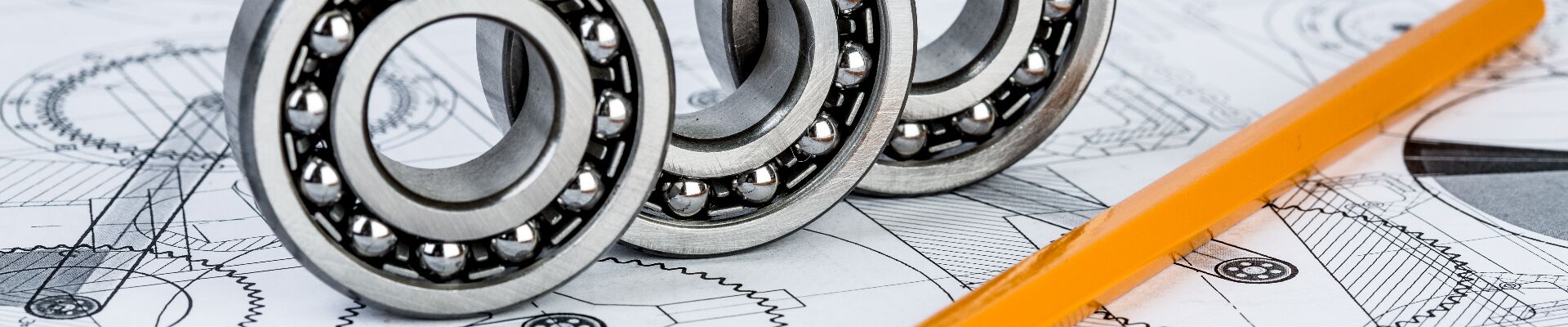
Miniature bearings – small body plates for large uses
Micro bearings refer to the metric series, with an outer diameter of less than 9mm; Imperial series, all types of bearings with an outer diameter of less than 9.525mm. The main materials are bearing steel, stainless steel, plastic, ceramic, etc., of which the inner diameter Z can be 0.6mm, and the general inner diameter is 1mm.
Micro ball bearings are made of carbon steel, bearing steel, stainless steel, plastic, ceramics and other materials, with a wide range of uses, suitable for high-speed rotation, low friction torque, low vibration, low noise requirements (carbon steel materials are rarely used by customers, for low-end customers).
1. Product characteristics
Micro bearings are suitable for all kinds of industrial equipment, small rotary motors, etc.; In recent years, there has been an increase in demand for miniaturization, lightweight, and thin-walled types of these devices.
In the ultra-small bore miniature bearings, there are 18 kinds of micro bearings with an inner diameter of φ2mm or less, and 6 kinds of imperial R series
2. Main uses
Office equipment Micro motors, soft drives Pressure rotors, dental drills Hard disk motors, stepper motors Video recorders Magnetic drums, toy models Computer fans, encoders and other fields.
3. Choose 11 elements of micro bearings
When choosing micro bearings, many factors need to be considered to avoid the selection type and other mistakes, and now summarize the 11 major elements of choosing micro bearings for your reference.
1. Miniature bearing radial load
The bearings that mainly bear radial loads are centripetal bearings. With a nominal contact angle of A0≤45°, roller bearings of the same size can withstand greater radial loads than ball bearings.
N-type and NU cylindrical roller bearings can only bear radial loads, while other types of centripetal bearings can bear both radial and axial loads.
2. Axial load of miniature bearings
The bearing that mainly bears axial loads is generally a thrust bearing, and its nominal contact angle A0>45°. Thrust bearings and thrust angular contact ball bearings can withstand axial forces in one or both directions at the same time, depending on the structure. When the bearing force is particularly high, thrust cylindrical roller bearings and thrust spherical roller bearings are preferred.
Thrust spherical roller bearings and unidirectional thrust angular contact ball bearings can bear both axial and radial loads, while other thrust bearings can only bear axial loads.
3. The length compensation of the micro imported bearing itself
Supporting a shaft and bearing usually adopts a combination of fixed bearing and traveling bearing. Traveling bearings compensate for shaft length errors and thermal expansion.
NU and N cylindrical roller bearings are ideal traveling bearings that compensate for length on their own. The inner and outer rings of the bearing can be tightly fitted.
4. Length compensation for the sliding fit of the miniature bearing
Non-separable miniature bearings, such as deep groove ball bearings and spherical roller bearings, can also be used as traveling bearings. One of the two ferrules of this type of bearing is mated and has no axial fixing surface. Thus, one of the ferrules of the bearing can be moved on its bearing surface.
5. Separable miniature bearings (accuracy)
This is a bearing that can be installed separately with ferrules, and its advantages are prominent when both ferrules are tightly fitted.
Separable bearings include four-point contact ball bearings, double-row angular contact ball bearings with double half inner rings, cylindrical roller bearings, tapered roller bearings, thrust ball bearings, thrust cylindrical roller bearings, and thrust spherical roller bearings.
Non-separable bearings include: deep groove ball bearings, single-row angular contact ball bearings, spherical ball bearings, and spherical roller bearings.
6. Micro bearing accuracy
In most cases, it is enough to apply rolling bearings of general size and rotational accuracy.
When the requirements are higher, bearings require higher accuracy ratings.
7. Micro bearings do not compensate for neutrality
Misalignment occurs when machining the journal mating surface or housing mating surface, especially when the mating surface is not completed in a single mounting. Misalignment can also occur when using housings (for example, flange housings or vertical housings). When the shaft is bent and deformed due to the working load, resulting in the tilt of the inner and outer rings of the bearing, misalignment will also occur.
Spherical bearings can compensate for misalignment and tilt, such as spherical ball bearings, centripetal and thrust spherical roller bearings. These bearings have a concave spherical outer ring raceway in which the rolling element and inner ring can rotate. The ability of these bearings to compensate for the center deflection angle of the shaft depends on their own type, size, and load profile.
Both spherical bearings and thrust ball bearings with races have a spherical bearing surface: the compensated deflection angle can be adjusted when installed in a concave spherical race.
8. Micro bearing speed
The friction of the single-row bearings is particularly low, so it is possible to reach Z-high speeds. These bearings are available in deep groove ball bearings that can only withstand radial loads and angular contact ball bearings that can withstand combined loads.
To improve the dimensional accuracy, rotation accuracy and mating part of the bearing, the use of lubrication and cooling methods, and the use of special types of cages can increase the allowable rotation speed of the bearing.
Low noise operation
Low operating noise is generally required in small motors, office equipment and household appliances.
9. Micro bearing conical hole
Bearings with conical bores can be mounted directly to tapered journals (e.g. single and double row cylindrical roller bearings in high-precision constructions). When installing these bearings, a given radial clearance can be adjusted.
Most spherical ball bearings, drum roller bearings and spherical roller bearings with conical bore can be mounted to a cylindrical journal with a tight sleeve. These bearings are particularly easy to install and remove.
10. Miniature bearing stiffness
The stiffness of imported bearings usually refers to the force required to produce a certain elastic deformation of the bearing. The bearings on the machine spindle and pinion shaft require a high degree of rigidity. Due to the different contact conditions between the rolling element and the raceway, the stiffness of roller bearings is higher than that of ball bearings.
11. Micro bearing friction
In addition to being heated and dissipated, internal friction also plays a significant role in determining the operating temperature of the bearing. Low friction bearings are: deep groove ball bearings with radial loads, miniature single-row angular contact ball bearings and cylindrical roller bearings with cages. Contact-sealed bearings, fully loaded cylindrical roller bearings, and thrust roller bearings all generate high friction.
Post time: Apr-27-2026


