


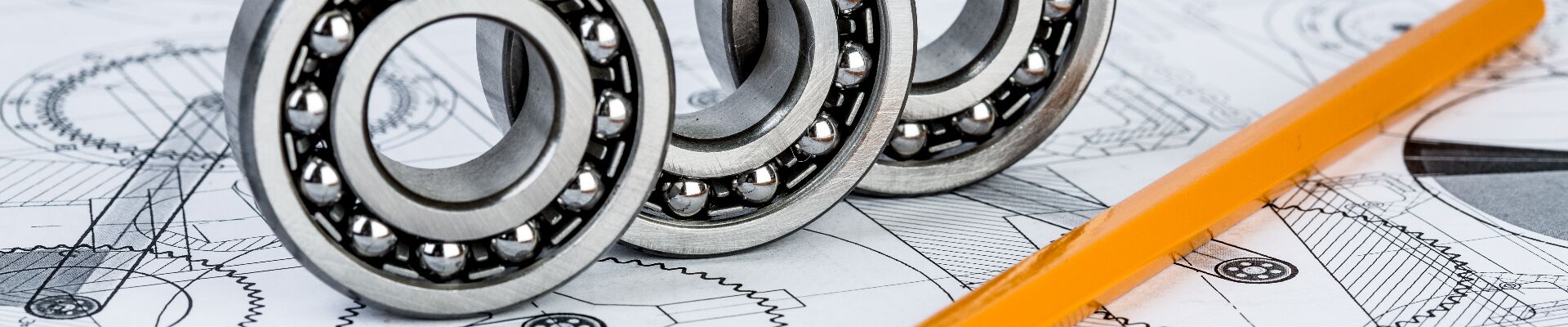
Rolling bearing cage guidance method
Among the several functions of rolling bearing cages, their guiding function (guiding and driving the rolling elements on the correct raceway) is very important, especially for high-speed bearings, which is almost a decisive constraint. In bearings, there is a gap between the cage and the ferrule and the rolling element, which can "swim freely" in the radial, axial, circumferential and angular directions, so it is the part with the least constraints of motion and the greatest degree of freedom. This "free swimming" characteristic has little effect on the bearing when running at low speeds, but the higher the bearing's speed, the more its smoothness and stability are disturbed. Under the superposition of the loads such as friction, collision force, centrifugal force and inertia force of the cage, it will lead to serious friction, wear, temperature rise, burning, deformation, vibration, noise and even failure of the bearing. Therefore, some form of guidance is needed to implement the cage to suppress or reduce this adverse effect so that the bearing can still function normally.
The so-called cage guidance means that during the operation of the bearing, the cage achieves the correction of the movement of the rolling element through the attachment and collision with the ferrule edge (or raceway) and rolling element. The guidance function and related performance of the cage are closely related to its guidance method. Especially in the design and application of high-speed bearings, the cage guidance method is an extremely important content, which needs to be paid attention to, and even special research and test verification must be carried out to meet the requirements.
1 Cage guidance mode and applicable working conditions The cage guidance method is commonly referred to as the "passive guidance method of the cage", that is, the way the cage is guided and driven by the ferrule or rolling element - when the rolling element enters the bearing bearing area, due to the driving effect of the friction between the two ring raceways, the revolutionary speed of the rolling element is greater than the rotation speed of the cage, and the rolling element pushes the cage to run at this time. At the same time, there is also a "cage active guidance mode", that is, the cage guides the movement of the rolling element - when the rolling element enters the non-bearing area of the bearing, due to the existence of clearance, the rolling element does not bear the load, and its revolutionary speed is reduced, at this time, it switches to being driven by the cage and guides the movement of the rolling element.
The main guidance methods of the cage are:
1) Rolling element guidance, outer ring (flange or raceway) guidance, inner ring (flange or raceway) guidance;
2) Mixed guidance methods such as "rolling element guidance + outer ring guidance", "rolling element guidance + inner ring guidance", "outer ring guidance + inner ring guidance", etc. Among them, the inner and outer ring guidance is collectively referred to as ferrule guidance.
Scroll body guidance
Rolling element guidance is the most commonly used cage guidance method - except for fully loaded rolling element bearings, as long as there is a cage, this guidance method exists, and it is suitable for medium and low speeds and normal load working conditions. The rolling element guidance is mainly metal (mild steel plate, copper plate, stainless steel plate, etc.) stamping cage (referred to as stamping cage) and polyamide 66 and 46 (PA66 and PA46), polyphenylene sulfide (PPS), polytetrafluoroethylene (PTFE) and other engineering plastic cages, and metal (copper alloy, aluminum alloy, alloy structural steel, etc.) solid cage (referred to as solid cage) for large-size bearings.
Ferrule guidance
Ferrule guidance can provide more accurate guidance for the cage compared to rolling element guidance, and can also suppress the vibration of the cage, which is conducive to the quiet operation of the bearing. Therefore, ferrule guidance is mainly suitable for high-speed, rapid acceleration and deceleration, medium and heavy loads, and large vibration conditions. The ferrule guidance is mainly based on solid cages and phenolic laminated cages (referred to as phenolic cages), as well as engineering plastic cages such as polyether ether ketone (PEEK) and polyimide (PI), and some use stamping cages.
2 General selection guidelines for cage guidance methods
(1) According to the running speed of the bearing
Low and medium speeds are guided by rolling elements
In addition to being simple, applicable and economical, the main reason is that under the condition of running speed, it is difficult to establish a hydrodynamic lubricating oil film between the cage and the ferrule guidance surface, and boundary lubrication or dry friction will lead to large temperature rise and rapid wear.
High-speed and rapid acceleration and deceleration are guided by ferrules
The main reasons for the use of ferrule guidance for high-speed bearings are: 1) "oil lubrication + high speed" is easy to form a good hydrodynamic full oil film lubrication on the cage guide surface;
2) Compared with the guidance of the rolling element, the dragging force of the cage on the rolling element can be reduced. Among them,
The characteristics of outer ring guidance are: 1) Due to material inhomogeneity or defects, processing and assembly errors, and geometric asymmetry in design, the cage will lead to mass eccentricity. Under the action of high-speed centrifugal force, the outer diameter guide surface of the cage along the eccentric direction of the mass will first be attached to the edge of the outer ring and cause friction and wear, so that the cage can achieve dynamic balance by itself. 2) Compared with the inner ring guidance, the inner and outer diameters of the cage are larger, and under the condition of the same number of rolling elements, the cage passer is wider, so the strength is enhanced; Or under the condition of the same cage lintel width, more rolling elements can be installed to further improve the stiffness and bearing capacity of the bearing. 3) The working temperature of the outer ring is usually lower than that of the inner ring, and the heat generated by the friction of the guide surface is easy to dissipate, and the lubrication state is more favorable. 4) When the inner ring rotates, the vortex trajectory of the center of mass of the outer ring guide cage is more stable than that of the inner ring guidance. 5) Because the radius of the outer ring flange is less than the radius of the raceway, under the influence of centrifugal force, there may be a risk of poor oil on the guide surface of the cage (radial oil holes can be designed at the edge of the outer ring to ensure the reliability of lubrication of the guide surface
The characteristics of inner ring guidance are: 1) Compared with the outer ring guidance, the eccentricity of the inner ring guidance will lead to the contact wear of the inner diameter guide surface of the cage at the opposite part of the centrifugal force, and its dynamic balance will deteriorate more and more (by improving the machining accuracy of the cage, carrying out precise and strict dynamic balancing, and ensuring good lubrication conditions, the negative effect of offset wear caused by mass eccentricity will be greatly reduced). 2) The sliding line speed of the cage guide surface and the inner ring flange is lower than that of the outer ring guide, so the friction and wear are less (more prominent in low-speed applications where low friction torque is required). 3) The size and mass of the cage are smaller than those of the outer ring guidance, and the centrifugal force is reduced when the material is reduced and rotation (but the number of rolling elements, bearing stiffness and load capacity are also reduced accordingly). 4) When there is a light load or directional load, the viscous drag force of the lubricating oil between the inner diameter guide surface of the cage and the inner ring flange forms the drag force on the cage, which can reduce the risk of slipping and rubbing of the rolling element. 5) When the inner ring straight raceway is guided, the initial running-in time of the bearing is short under grease lubrication conditions; Under oil-lubricated conditions, the lubricating oil inside the bearing does not accumulate.
Post time: May-22-2026


