


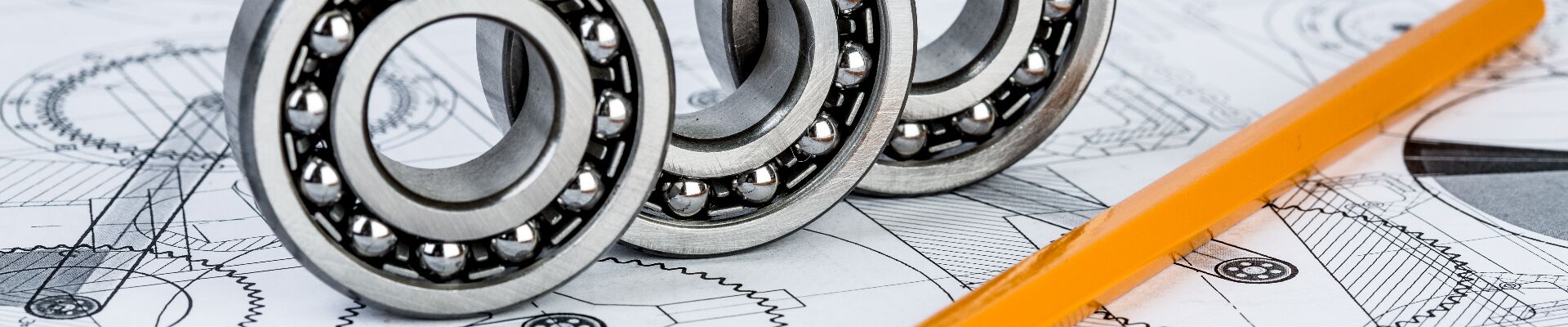
Several Factors to Consider When Selecting Bearings
"Various types of bearings have different characteristics due to their varying designs. Because of the variability and complexity of bearing installation locations and applications, there is no fixed pattern for bearing type selection. When selecting bearing types to adapt to the specific installation location and application conditions of a particular host machine, it is recommended to consider the following main factors comprehensively."
Allowable Space: In mechanical design, the shaft dimensions are generally determined first, and then the bearing is selected based on those dimensions. Typically, ball bearings are used for small shafts; cylindrical roller bearings, self-aligning roller bearings, and tapered roller bearings (sometimes ball bearings can also be used) are used for large shafts. If the radial space of the bearing installation location is limited, bearings with a smaller radial section height should be used. Examples include needle roller bearings, certain series of deep groove ball bearings, angular contact ball bearings, cylindrical roller or self-aligning roller bearings, and thin-walled bearings. If the axial space of the bearing installation location is limited, bearings with a smaller width dimension can be used.
**Bearing Load:** Load size is usually the determining factor in selecting bearing size. Roller bearings have a greater load capacity than ball bearings with the same external dimensions. Generally, ball bearings are suitable for light or medium loads, while roller bearings are suitable for heavy loads.
Load Type: For pure radial loads, deep groove ball bearings or cylindrical roller bearings can be used. For pure axial loads, thrust ball bearings or thrust cylindrical roller bearings can be used. When there are both radial and axial loads (combined loads), angular contact ball bearings or tapered roller bearings are generally selected. If the radial load is large and the axial load is small, deep groove ball bearings and cylindrical roller bearings with flanges on both the inner and outer rings can be used. If there is also a large shaft or housing deformation or poor installation alignment, self-aligning ball bearings or self-aligning roller bearings can be used. If the axial load is large and the radial load is small, thrust angular contact ball bearings can be used. For four-point contact ball bearings, if self-aligning performance is also required, thrust self-aligning roller bearings can be used.
Speed: The operating speed of a rolling bearing mainly depends on its allowable operating temperature. Bearings with low frictional resistance and less internal heat generation are suitable for high-speed applications. When subjected to only radial loads, deep groove ball bearings and cylindrical roller bearings can achieve higher speeds. For combined loads, angular contact ball bearings are preferable. High-precision angular contact ball bearings with special designs can achieve extremely high speeds. The speeds of all thrust bearings are lower than those of radial bearings.
Rotational Accuracy: For most machinery, bearings with a tolerance of grade 0 are sufficient to meet the requirements of the host machine. However, when there are strict requirements for shaft rotational accuracy, such as in machine tool spindles, precision machinery, and instruments, higher tolerance grades of deep groove ball bearings, angular contact ball bearings, tapered roller bearings, cylindrical roller bearings, and thrust angular contact ball bearings should be selected.
Rigidity: The rigidity of a rolling bearing is determined by the amount of elastic deformation that occurs when it bears a load. Generally, this deformation is very small and can be ignored. However, in some machinery, such as machine tool spindle systems, the static and dynamic stiffness of the bearing has a significant impact on the system characteristics. Generally speaking, roller bearings have higher rigidity than ball bearings. Various bearings can have their rigidity improved to varying degrees by appropriately pre-tightening them.
Noise and Vibration: Bearings themselves generally have low noise and vibration. However, for machinery with specific requirements for noise and smooth operation, such as small and medium-sized motors, office equipment, household appliances, and instruments, low-noise bearings are typically selected.
Axial Movement: The most common bearing configuration involves installing a fixed bearing (axially positioned) at one end of the shaft and a free-moving floating bearing (axially movable) at the other end to prevent seizing due to thermal expansion and contraction. Commonly used floating bearings are cylindrical roller bearings with no flanges on the inner or outer ring. In this case, an interference fit can be used between the inner ring and the shaft, or between the outer ring and the housing bore. Sometimes, non-separable deep groove ball bearings or self-aligning roller bearings can be used as floating bearings, but during installation, a clearance fit should be selected between the inner ring and the shaft, or between the outer ring and the housing bore, to ensure sufficient axial movement freedom for the inner or outer ring.
Frictional Torque
Ball bearings have lower frictional resistance than roller bearings. Under pure radial loads, radial contact bearings have lower frictional resistance; under pure axial loads, axial contact bearings have lower frictional resistance; under combined loads, angular contact bearings with contact angles close to the load angle have the lowest frictional resistance. In instruments and machinery requiring low frictional torque, ball bearings or cylindrical roller bearings are more suitable. Furthermore, low-friction torque bearings should avoid contact seals, and drip lubrication, oil-air lubrication, or other lubrication methods that reduce friction are recommended.
Installation and Removal
Bearings with cylindrical bores are used in machinery with frequent installation and removal. Separable angular contact ball bearings, tapered roller bearings, separable cylindrical roller bearings, needle roller bearings, and thrust bearings should be preferred. Bearings with tapered bores can be mounted on journals or, with the aid of adapter sleeves or withdrawal sleeves, on cylindrical journals, making installation and removal very convenient.
Post time: Jul-20-2026


