


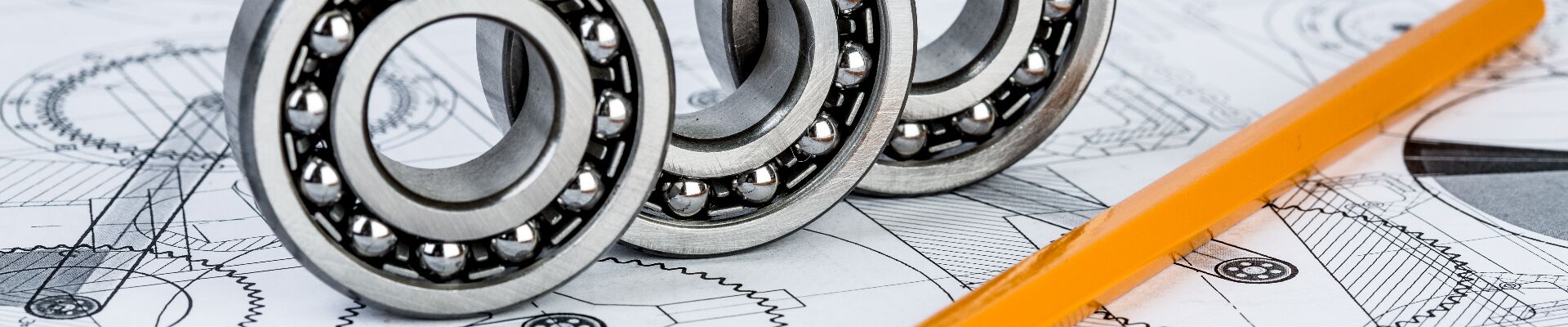
Sliding Bearings and General Manufacturing Materials
A sliding bearing is a bearing that bears loads by utilizing the sliding motion between a shaft and a bearing.
Based on the different principles of oil film formation on the two relatively moving surfaces of a sliding bearing, it can be divided into hydrodynamic bearings (also called hydrostatic bearings) and hydrostatic bearings (also called hydrostatic bearings).
Generally, we discuss hydrodynamic bearings. They use the relative motion between the shaft and the bearing to bring oil between the two surfaces, forming a sufficient pressure film to separate the two surfaces and thus bear the load.
Commonly used bearing materials are divided into two categories: metallic materials and non-metallic materials.
(1) Cast Iron. Ordinary gray cast iron or wear-resistant gray cast iron alloyed with nickel, chromium, and titanium, or ductile iron can all be used as materials for light-load, low-speed bearings. In these materials, the flake or spherical graphite components, after covering the material surface, can form a graphite layer that provides lubrication. Phosphating the surface of wear-resistant cast iron creates a porous thin layer, which helps improve its wear resistance.
(2) Bearing alloys. (Usually Babbitt alloy or white alloy) Bearing alloys are divided into two main categories: one is tin-based, with appropriate amounts of antimony and copper added, called tin-based bearing alloys, such as ZChSnSb11-6; the other is lead-based, with appropriate amounts of tin and antimony added, called lead-based bearing alloys, such as ZCnPbSn16-16.
(3) Copper alloys. Copper alloys can be divided into: cast lead bronze; cast tin-zinc lead bronze; cast tin-phosphorus bronze; cast aluminum bronze; and cast brass.
Sliding bearings and general manufacturing materials for sliding bearings
(4) Aluminum alloys. They are divided into two categories: low-tin aluminum alloys, containing approximately 6.5% tin; and high-tin aluminum alloys, containing up to 20% tin.
(5) Ceramic metals. This is a bearing material made by pressing and sintering different metal powders. This material has a porous structure, with pores accounting for approximately 10% to 35% of its volume. Before use, it is soaked in hot oil to fill the pores with lubricating oil, giving it self-lubricating properties; it is also called an oil-impregnated bearing.
(6) Graphite. Graphite bearings can be made of pure graphite, which has lower strength; alternatively, plastics, resins, silver, copper, or Babbitt metal can be added to improve strength and adaptability.
Sliding bearings and general manufacturing materials for sliding bearings
(7) Other non-metallic materials.
1) Rubber. Mainly used in areas where water is used as a lubricant and where there is considerable dirt.
2) Phenolic resin cloth. It is a layered material made of cotton cloth, asbestos cloth, or other synthetic fiber cloth bonded together with phenolic resin.
3) Nylon. Used in low-load bearings.
Post time: Sep-04-2026


