


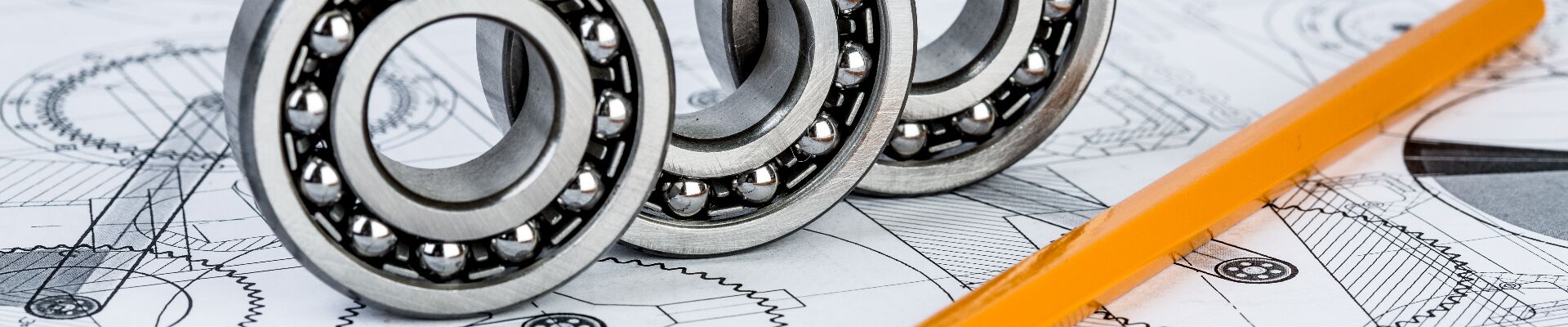
Special Family of Bearings
In routine equipment maintenance, deep groove ball bearings or cylindrical roller bearings are often the most familiar. However, with the increasing complexity of industrial environments, conventional "regulars" often struggle to handle extreme operating conditions. Understanding these special bearings not only broadens our maintenance perspective but also helps us accurately diagnose and resolve complex equipment problems.
Spherical Plain Bearings: Flexible Universal Joints
Spherical plain bearings come in handy when equipment components not only need to rotate but also swing within a certain angle. Their ingenious structure consists of an outer spherical inner ring and an inner spherical outer ring, much like a ball-and-socket joint in the human body. This design allows them to withstand radial, axial, or complex combined loads simultaneously. They are found in the linkages of engineering machinery, the opening and closing mechanisms of bridge gates, and even the flexible joints of humanoid robots. To adapt to different environments, they are divided into conventional types that require regular grease lubrication, and self-lubricating types with special inner linings, requiring no maintenance and significantly reducing the frequency of later maintenance.
Linear Motion Bearings: Precision "Translation" Guide Tools
Not all bearings are designed solely for rotation. Linear motion bearings are "translation masters" specifically designed for linear reciprocating motion. Whether linear ball bearings or roller guide supports, they convert sliding friction into rolling friction, resulting in extremely low friction coefficients and extremely high motion rigidity. They are indispensable core components in components requiring high-precision positioning and smooth movement, such as CNC machine tool slides and industrial robot guides, ensuring the accuracy of every movement of the robotic arm.
Combined Bearings: Extremely Compact "All-Rounder"
In space-constrained precision equipment, how can radial and axial force problems be solved simultaneously? Combined bearings provide the perfect answer. They cleverly integrate two different types of bearings (such as needle roller bearings and thrust ball bearings, or needle roller bearings and angular contact ball bearings) into a single unit. Taking NKX or NKIA type combined bearings as an example, this "one set does the work of two" design not only significantly reduces the axial dimensions and weight of equipment but also simplifies installation procedures, making it an excellent choice for compact transmission systems such as hydraulic pumps and machine tool gearboxes.
Special Material Bearings: "Tough Guys" Challenging Extreme Environments
When equipment is exposed to extreme environments such as high temperatures, strong corrosion, or strong magnetic fields, ordinary bearing steel will quickly fail. In such cases, bearings made of special materials become the key to overcoming these challenges. For example, ceramic bearings made of silicon nitride ceramics are not only 60% lighter than steel balls but can also operate stably at temperatures up to 1200℃, making them standard equipment for aero engines and high-speed precision machine tools. In corrosive industries such as chemical, marine, or food and pharmaceutical industries, 316L stainless steel bearings are a reliable line of defense against corrosion. Furthermore, there are magnetic bearings that achieve zero wear using the principle of magnetic levitation, and fluid bearings that rely on compressed gas for load bearing; these are constantly pushing the physical limits of mechanical transmission.
Post time: Aug-12-2026


