


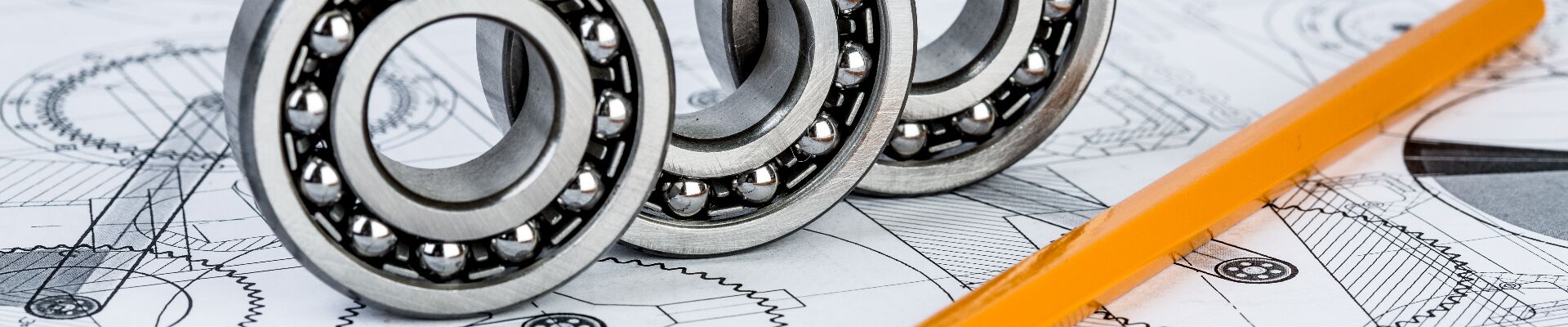
Support Bearings VS Thrust Bearings
1. Support Bearings and Their Function
Support bearings are an important component of a steam turbine. The main bearing is also called a radial bearing.
Its function is to support the entire weight of the rotor and the centrifugal force caused by rotor mass imbalance, and to determine the correct radial position of the rotor within the cylinder. Since each bearing must withstand high loads and the shaft journal rotates at high speeds, the bearings of a steam turbine use journal type sliding bearings based on the principle of fluid lubrication. A pressurized lubricating oil film forms between the shaft journal and bearing, generating fluid friction to ensure the safe and stable operation of the steam turbine.
There are four main types of steam turbine main bearings: cylindrical shell support bearings, elliptical shell support bearings, three-oil wedge support bearings, and tilting pad support bearings.
2. Function of Thrust Bearings
The function of a thrust bearing is to withstand the axial thrust of the rotor during operation and to determine and maintain the axial relative position of the turbine rotor and cylinder.
Thrust bearings can be designed as independent units or combined with support bearings into a single unit, called a combined (thrust-support combined) bearing.
Structurally, they can be multisegment or sector-shaped; currently, the most widely used type is the sector-shaped bearing. Its main components include working pads, non-working pads, adjustment shims, and mounting rings.
On both sides of the thrust disc, ten to twelve working and non-working pads are installed. Each pad is mounted on a mounting ring; the working pads bear the forward axial thrust of the rotor, and the non-working pads bear the reverse axial thrust.
The non-working pads of the thrust bearing do not normally bear any thrust. However, when the turbine load suddenly decreases, such as in a load rejection, the turbine may experience axial thrust in the opposite direction of the airflow. At this time, the non-working pads, through their wedge-shaped oil film, help balance this portion of the axial thrust, preventing excessive forward displacement of the turbine and avoiding collisions and wear between moving and stationary parts.
3. TSI Monitoring Parameters During Steam Turbine Operation
1. Support bearing metal temperature < 105°C.
2. Thrust bearing metal temperature < 100°C.
3. Working face temperature of thrust pads < 100°C.
4. Non-working face temperature of thrust pads < 100°C.
5. Axial displacement < 1.2 mm and > -0.6 mm.
6. High and medium-pressure cylinder differential expansion < 6 mm and > -3 mm.
7. Bearing cap vibration < 0.05 mm, shaft system vibration < 125 μm.
8. Deviation in relative expansion of left and right cylinders should be small.
Post time: Apr-09-2026


