


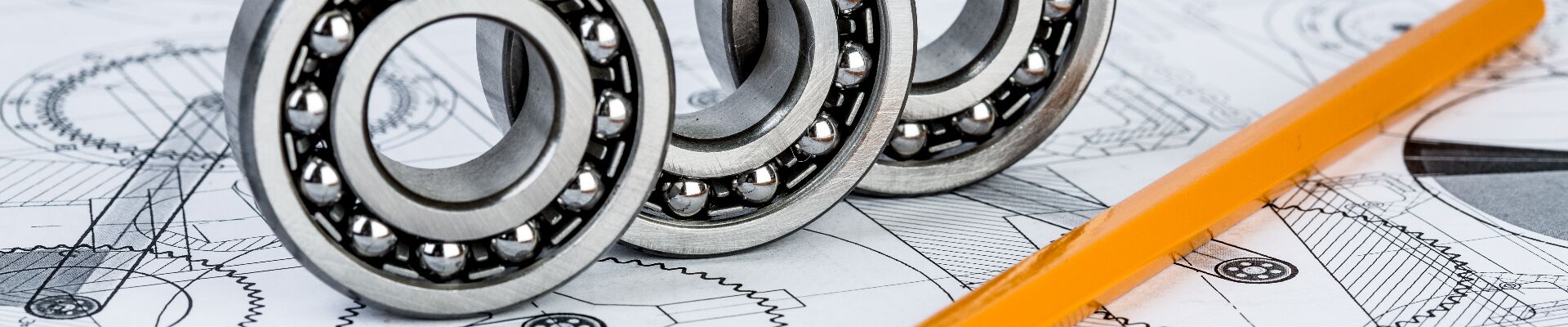
The guidance method is selected according to the bearing cage form
The stamping cage is guided by a rolling element
The stamping cage is light in weight, medium in strength, small in moment of inertia, and easy to drive and guide. In addition, the stamping cage has a small cross-sectional size, which can make the lubricating oil road smooth; When grease lubrication, it is convenient to grease the inside of the bearing and has a larger grease storage space, which is conducive to ensuring and extending the maintenance-free cycle or durability life of the bearing. However, the stamping cage has weak stiffness and is not resistant to wear under conditions such as high speed, rapid acceleration and deceleration, and direction change. Stamping cage is mainly used for small and medium-sized bearings and below, rolling element guidance; There are also some types of bearings that are guided by ferrules, such as the M-type cage of cylindrical roller bearings as the outer ring guide
Solid and engineering plastic cages are guided by ferrules or rolling elements
Solid cages are usually used in high-strength occasions and large-size bearings, which can allow higher working speed and operating temperature compared with stamped cages, and can withstand heavier loads or complex loads such as vibration, shock, direction change, and variable load, but because of the larger mass, it also requires greater drag force to drive it; Because the material is stronger, it can save space in the cage, reduce the spacing between the pockets, increase the number of rolling elements, and increase the bearing load capacity. Taking the commonly used brass solid cage as an example, it has the advantages of high strength, "low friction pair" with bearing steel ferrule, small risk of "sticking", good wear characteristics, less abrasion, corrosion resistance, easy to ensure processing accuracy, and high reliability of use.
Compared with stamping and solid cages, it has lightweight (small moment of inertia, small torque fluctuation), good strength and elasticity (more rolling elements can be loaded, can be returned to the original state after force deformation), low noise (with vibration damping effect), adaptable to high sliding line speed (smooth surface, wear resistance and abrasive chips will not cause pollution and deterioration to lubricating grease like metal cage abrasives). It has significant advantages such as good boundary lubrication performance (low friction, low temperature rise, self-lubrication) and high safety (even if it is rolled into a flake after fragmentation, it can continue to work for a short time without causing sudden disasters).
Engineering plastic cages commonly used for rolling element guidance are:
1) PA cage. PA66 cage is economical in cost and has excellent comprehensive performance, but its temperature resistance and dimensional stability are poor, so it is difficult to adapt to the guidance of ferrules with greater sliding friction. As an "upgraded version" of PA66 cage, PA46 cage has better performance in temperature resistance, oil resistance, wear resistance, creep resistance, fatigue resistance, etc., and is well applied in bearings such as automobile AC engines, gearboxes, air conditioning compressors, etc.
2) PTFE cage. PTFE is known as the "king of plastics", which has the smallest friction coefficient (ideal oil-free lubricating material), the widest temperature resistance range (-196~260 °C), the best anti-aging performance, the smallest surface tension without adhering to any substance, and almost no corrosion from any chemical reagents, so PTFE cages are very suitable for corrosion-resistant bearings, non-magnetic bearings, rocket engine bearings, etc.
3) PPS cage. PPS has high hardness and high rigidity, which is rare in engineering plastics, especially at high temperatures, it still has good chemical stability (second only to PTFE), even in the environment of compressor oil, gear oil, ammonia refrigerant and other environments, its strength, hardness, rigidity, wear resistance and other comprehensive performance is still excellent, so PPS cages are well used in bearings such as high-speed compressors.
The engineering plastic cages mainly used for ferrule guidance are:
1) Phenolic cage, with low material density, porous oil immersion and oil absorption, low friction coefficient and other excellent properties, is very suitable for ferrule guidance during high-speed operation, is the "standard" cage of high-speed precision bearings represented by machine tool spindle bearings.
2) PEEK cage, with the perfect combination of strength and elasticity, excellent high temperature resistance and sliding friction characteristics, very outstanding fatigue resistance under alternating stress (the best in engineering plastics, comparable to alloy materials), and superior dimensional stability (injection molding shrinkage rate is small, so the processing accuracy is much higher than that of general engineering plastics, and temperature and humidity changes have little impact on product size, so it can meet the requirements of high-precision use). In machine tool bearings, ultra-high speed bearings designed for oil and gas lubrication (DMN value up to 3.0× 106 mm · r/min) with low temperature rise and low non-repeatable run-out (NRRO), especially under the condition of micro lubrication.
3) PI cage, with the advantages of wear resistance, self-lubrication and high strength, its porous structure is widely used in long-life spacecraft gyromotors, navigators, momentum wheels and other bearings after vacuum immersion treatment.
Bearings of the same size specification and tolerance level have a significant impact on their speed performance when different forms of cages are used: taking angular contact ball bearings as a reference comparison, the ultimate speed of solid cage bearings is only about half of that of phenolic cage bearings, while the ultimate speed of stamped cage bearings is about 80% of that of solid cage bearings.
Rotate the ferrule according to the bearing
when the inner ring rotates and the outer ring is stationary, the inner ring guides; When the outer ring rotates and the inner ring is stationary, the outer ring guides; When both the inner and outer rings rotate, the rolling body guides.
This is due to the fact that when the inner ring rotates, the inner ring is used to guide, and the friction between the inner ring flange and the cage constitutes the driving force of the cage; The friction generated by the outer ring guidance constitutes resistance to the cage. When the outer ring rotates, the outer ring should be used. When the inner and outer rings rotate, it is advisable to use a rolling element to guide, and the same is true.
The above criteria are only considered from the simple perspective of friction, and the selection should be comprehensively considered in actual use. Take the most common inner ring rotation and outer ring stationary in practical applications as an example: the outer ring guidance is mostly used at high speed, because the stationary outer ring is more stable, and other outstanding advantages mentioned above; while heavy-duty or large-size bearings are mostly guided by inner rings to reduce the starting torque and rotational torque of the cage.
According to the ferrule with flange
When the outer ring has a flange, the outer ring guides (such as NU type cylindrical roller bearings); When the inner ring has a flange, the inner ring guides (such as N-type cylindrical roller bearings); Both ferrules have flanges, which are determined according to the installation, operation and maintenance requirements of the bearing. There are also ultra-precision cylindrical roller bearings developed by Schaeffler in Germany as shown in Figure 5, which do not use ferrule flanges as the guide surface. Because the raceway size, shape processing accuracy and surface roughness are stricter than ferrule edge requirements, the guidance of the cage is also more accurate and smooth. The ferrule raceway guidance is used to maximize the number of rollers, that is, the bearing bearing capacity, and the cage position can also tend to the top of the rolling element (when the outer ring is guided) or the bottom (when the inner ring is guided) to achieve the ultimate of its inner and outer diameter dimensions.
Post time: May-25-2026


