


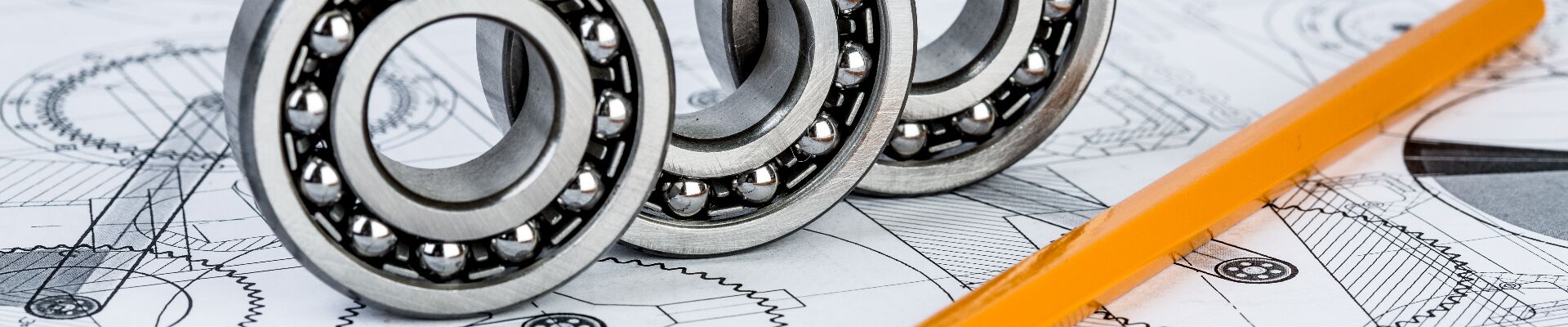
What are the basic requirements for bearing materials?
The most common material for bearings is bearing steel. The internal structure, chemical composition uniformity, non-metallic inclusions, carbide particle size and distribution, and decarburization degree of bearings have very strict requirements. Otherwise, these defects will significantly shorten the service life of the bearing and the applicability of the material.
1. Purity of Bearing Steel: Fatigue spalling of bearing parts is related to non-metallic inclusions in the steel, especially oxides. This is because when a rolling bearing rotates, the contact surfaces of the bearing parts are subjected to pulsed loads. Non-metallic inclusions cause localized disruption of the continuity of the steel matrix structure, leading to stress concentration, plastic deformation around the non-metallic inclusions, and the formation of microcracks.
In addition, the content of gases (oxygen, nitrogen, hydrogen) in the bearing steel is also an important indicator of purity. Oxygen dissolved in steel precipitates as temperature decreases and forms oxide inclusions with elements such as aluminum, calcium, silicon, and manganese. Nitrogen forms highly dispersed aluminum nitride inclusions and relatively coarse titanium nitride and titanium carbonitride inclusions in the steel. When aggregated hydrogen atoms combine to form hydrogen molecules, they generate immense pressure. Once this pressure exceeds the steel's strength limit, internal cracks occur, forming white spots. Reducing the gas content is a crucial step in improving the purity of bearing steel.
In recent years, many major bearing steel producers in my country have successively built and put into operation ultra-high power electric arc furnaces, employing advanced eccentric hearth tapping technology for secondary refining. This reduces the oxygen content in the steel to approximately 10 × 10⁻⁶, with some individual examples reaching as low as (4~3) × 10⁻⁶. The secondary refining ratio also reaches 100%. Therefore, the number of inclusions in the steel is well controlled.
2. Uniformity of Bearing Steel
The uniformity of bearing steel refers to the uniformity of its chemical composition and carbides. The structure, weight, casting temperature, and casting method of steel ingots affect the distribution of chemical composition in steel. The heating process of steel ingots and billets before hot working, the termination temperature of hot working, and subsequent cooling methods, as well as spheroidizing annealing processes, affect the uniformity of carbides. Based on the shape, distribution, and formation causes of carbide inhomogeneity in the microstructure of bearing steel, carbides can be classified into liquid carbides, banded carbides, and network carbides. The harmfulness of liquid carbides is equivalent to that of inclusions in steel. Banded carbides rated 3-4 can reduce the fatigue life of steel by 30%. Increasing the network carbides by one grade can reduce bearing life by one-third. The size of carbide particles directly or indirectly affects bearing life. The rating of liquid carbides, banded carbides, and network carbides is an indicator of carbide uniformity.
3. Dimensional Accuracy and Surface Quality of Steel
Improving the dimensional accuracy of steel not only increases the utilization rate of bearing materials but also reduces unnecessary machining operations. Some steel mills have adopted high-rigidity rolling mills with short stress lines, significantly reducing the dimensional deviation of steel cross-sections. For round steel with a diameter of less than 30mm, the diameter deviation can be as low as 0.3mm.
The lifespan and reliability of bearings are related to factors such as the bearing's structural design, materials used, hot and cold processing techniques and equipment, installation, and operating conditions. Among these, materials and heat treatment are among the main factors affecting bearing lifespan and reliability. Due to the influence of materials and heat treatment processes, factors such as low material strength, poor purity, unreasonable fiber orientation in metal materials, low hardness, unsuitable forging ratios, and high residual stress can easily lead to bearing damage. In foreign countries, the impact of steel quality on bearing lifespan was approximately 50% in the 1950s and 60s, decreasing to one-third in the 1980s. Currently in my country, due to the influence of processes and equipment, the quality of bearing steel accounts for approximately 60% of bearing lifespan. Therefore, for bearing manufacturers, selecting qualified and high-quality bearing materials is also a key factor in improving bearing lifespan.
Post time: Aug-27-2026


